SEO stands for Search Engine Optimization. You'll find that sentence on hundreds of websites, usually followed by the same explanation about “the three pillars” and a list of tips. I'd rather explain it from my own work as an SEO specialist: what I see with clients every day, with the examples and numbers that go with it, and also what doesn't work.
Not familiar with the basic terms yet? Then it helps to read the SEO glossary first. It explains terms like “crawling”, “indexing” and “SERP” clearly.
Two misunderstandings that keep coming back
“Can you do a bit of SEO?”
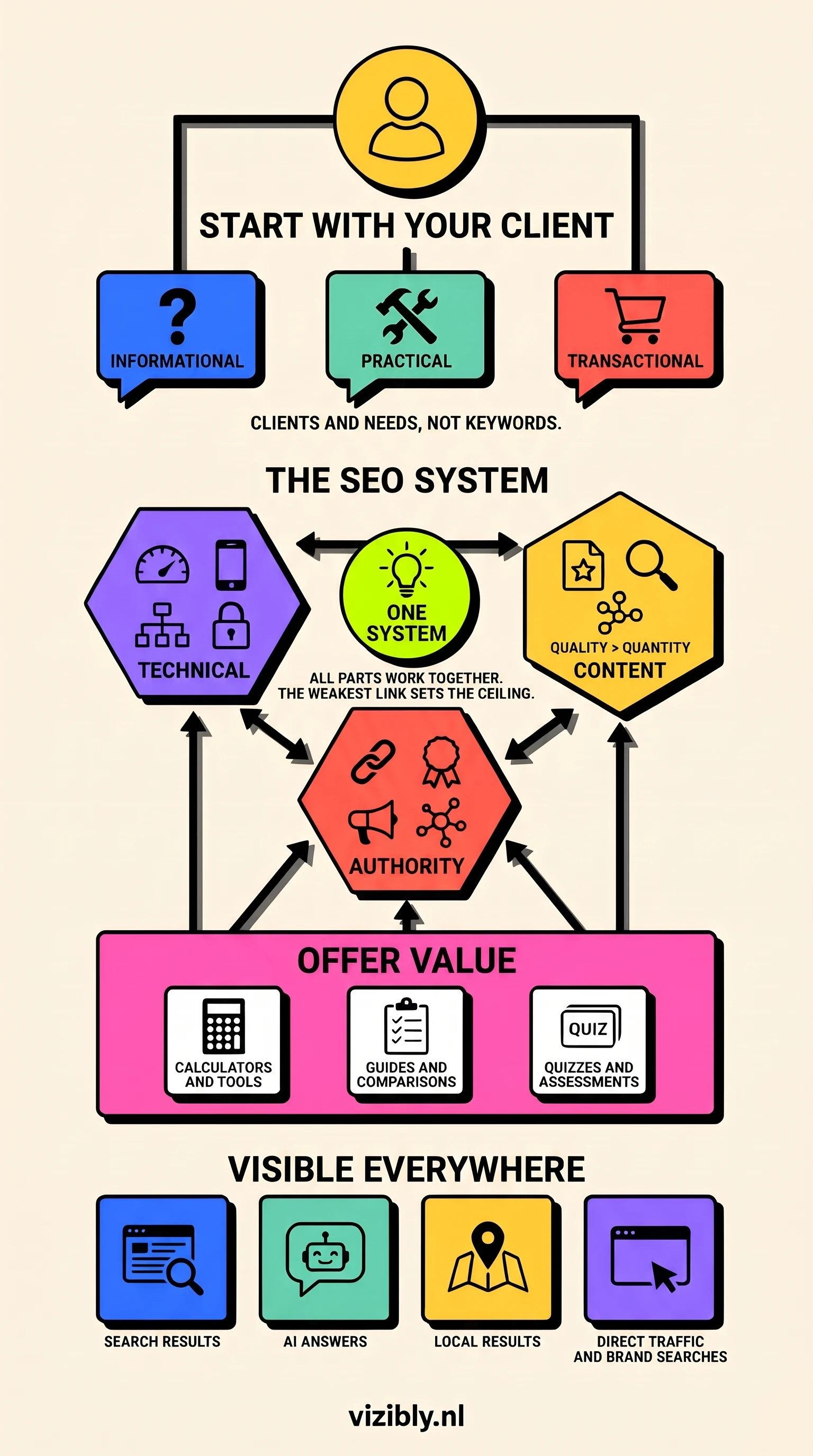
This may be the most persistent misunderstanding. You don't add SEO afterward once your website is finished, like a coat of paint over a wall. It's a system in which the technical side of your site, the content on it and the authority you build work together. And that system has to be better than your competitors'.
So you need to know who your competitors are and where they leave gaps that you can fill. To do that, you start with a question many business owners skip: who is your audience, and what are they searching for?
An example. An international real estate agent came to me asking whether I could “arrange a few backlinks”. According to him, that was the only thing missing. When I dug into the site, it turned out the CMS was producing thousands of filter pages. Thin pages with no content that all ended up in Google's index. The pages that were supposed to rank lacked focus and had little to offer the visitor. Backlinks were the least of his problems. The whole foundation had to be put in order first.
“We just need to make more content”
Content is an important part of SEO, but it's not the whole picture. I regularly see companies publishing dozens of blog posts while their technical foundation isn't in order. All that writing then ends up on a site Google struggles with.
Or the other extreme: “I put the word ‘loodgieter Amsterdam’ (plumber Amsterdam) on my homepage, so I'll rank for it, right?” Then that homepage sits at position 150. Putting a keyword on your page is only the beginning. After that, the page has to answer the searcher's question, be technically sound and get support from other sites that link to it.
What SEO means in 2026
SEO is a system for bringing in customers through search engines and AI. The goal is to be consistently findable for people who are actively looking for your service or product.
That definition sounds simple, but there's a shift in it. Until a few years ago, SEO mostly meant: get as high in Google as possible. Position 1, and you were done.
Now Google increasingly answers in the search results itself, through AI Overviews: the summary that sits above the regular results. As a result, fewer people click through to a website, and a large share of searches ends without a click. Tools like ChatGPT and Perplexity even answer questions without a search result being involved.
What this means for SEO
Ranking at the top is no longer enough. Your page has to give the answer to your customer's question. That answer can be in Google, in an AI summary or on Reddit: wherever your customer searches.
AI Overviews appear mostly for informational questions, where people want to know something: “what is SEO”, “how does a heat pump work”. Few customers come from that kind of search. Searches with buying intent, which do bring in customers, are affected less. And even with an informational question, you stay visible if your brand is named in that AI summary.
People haven't switched en masse, by the way: according to figures from Similarweb, around 95 percent of ChatGPT users also still use Google. So you want both: to be found in the regular search results and to be named in an AI-generated answer.
SEO starts with a website that helps your customer
A lot of SEO content on the internet is interchangeable. Companies use the same keyword tools (programs that show what people search for), find the same keywords and so write the same copy. The result: dozens of pages that say mostly the same thing, just in slightly different words. Your visitor notices that, and so do Google and AI tools.
What does work: starting with your customer. What questions do they have? What problems and doubts? Sometimes those are questions your customer hadn't thought of yet. If you answer them on your website, with knowledge and experience you have yourself, you build something a competitor can't simply copy.
This is called utility marketing: your website helps your customer choose, calculate or solve something.
An example: for a technical online store I built a buying guide that helps customers choose the right heat recovery unit. An independent comparison, not a product page. That page ranks in the top 3 of Google, gets visited hundreds of times a month, and drives a measurable rise in conversions. Another example: a statutory interest calculator, built for a collections agency. It sounds simple, but the result was more conversions and fewer questions from customers, because the tool already did the work.
Vizibly's own free SEO checker and website checker work the same way. You get an answer to your question right away, without having to buy anything, and that's exactly what someone types into Google for. Want to know more about this approach? Read the article on micro-tools on your website.
KEY POINT: SEO lives in the pages themselves. The more your visitor gets out of them, the more reason Google has to show you.
The three parts of SEO, and how they fit together
Every explanation of SEO names the same three parts: technical SEO, content and authority. That's right. What most explanations leave out is that they depend on each other: the weakest part holds back the other two.
Technical SEO: fast, mobile and readable for Google
Your site has to load fast, work well on mobile and be technically sound, so Google (and AI tools) can find and understand the content. Think structured data (code that tells Google what is on a page), a clean sitemap, no duplicate pages in the index and correct canonical tags, which indicate which version of a page is the real one. As a visitor you don't see any of it, but Google reads all of it.
Many small and mid-sized businesses run on WordPress, and I regularly see it hold them back. WordPress works fine for many sites, but once you want to optimize down to the detail, it becomes limited and awkward. Pages load slowly, plugins get in each other's way, and even getting a good PageSpeed score is a lot harder in WordPress than it needs to be.
Content: every page answers one question
Content mostly means: answering your customers' questions, with knowledge you have yourself. The difference is in focus. Google looks for the best page on one specific topic, and a page that touches on ten topics in passing isn't that for any of the ten.
What I often see: companies that do have pages, but without a clear focus. Or far too few pages for the number of topics they want to rank for. A homepage and an “about us” page is not a content strategy. You need pages that each answer a specific question and together build topical authority.
Authority: what other sites say about you
You build authority with backlinks (other sites that link to you), with mentions on the web, with reviews and with expertise you keep demonstrating. In 2026 this carries more weight than before, because AI tools also look at what other sites say about a brand before they consider it trustworthy.
This is the part I see neglected most often. Companies invest in a nice site and good copy, but nothing happens outside their own website: nobody links to them or mentions them anywhere. Then they get stuck, however good the site itself is.
You can read how these three parts work together in a long-term approach in the article on SEO strategy.
How Google judges quality: E-E-A-T
Google uses four yardsticks to judge whether content is trustworthy, together called E-E-A-T. It stands for Experience, Expertise, Authoritativeness and Trustworthiness. They are guidelines that Google's quality raters, people who review search results by hand, use to look at websites. So you can't simply switch E-E-A-T on somewhere.
What it comes down to: Google wants to be sure the content on your website was written by someone who knows the subject, and not by someone who googled a keyword and built a text around it. That applies even more to topics that affect someone's health, finances or safety.
For that, you show who you are and what you have done. Show your real-world results. Write from your own experience instead of summarizing what others have already written. Make sure your contact details are correct, that you have reviews and that other sites link to you. If you do good work, you usually already have that proof; it just has to be on your site.
SEO or Google Ads?
A question I get often. The short answer: it depends.
SEO brings in lasting traffic that grows over time. You invest now, and the results add up. Google Ads (SEA) delivers results right away, but stops as soon as you stop paying. For businesses that need visibility fast, Google Ads can be the smarter choice in the short term.
You get the best result by combining SEO and Google Ads. You use data from ads, such as which keywords convert, to sharpen your SEO strategy. And once you rank well organically, you can shift your ad budget to new keywords.
Local SEO: findable in your area
For many small and mid-sized businesses, local findability matters more than national rankings. If you're a plumber in Utrecht, you don't need to be on page 1 for “loodgieter Nederland” (plumber Netherlands). You want to be found by people in Utrecht who are looking for a plumber right now. That is local SEO.
The basis is your Google Business Profile. It's free, and it determines whether you show up in Google Maps and in the local results block (the three businesses you see at the top for “near me” searches). Fill it in completely: photos, opening hours, services, a good description. And actively ask for reviews. Reviews carry a lot of weight in Google's local rankings, and potential customers read them.
It also helps to have local content on your website. A page about your services in your area, listings in local business directories, and the same business details everywhere on the web: name, address and phone number. It sounds simple, and it is. Still, many businesses let it slide.
What does SEO deliver?
A few examples from my own practice:
- Online florist: from 1,700 to 10,000 visitors a month, with a lasting increase in revenue from organic traffic.
- Technical online store: +145% revenue from organic traffic, partly thanks to that buying guide I mentioned earlier.
- Roofer in Haarlem: from invisible to the top of the local search results.
Worth knowing: this takes months, not weeks. With the florist, it took half a year before the growth became clearly visible. SEO is an investment in the medium term. If someone promises you'll be number 1 within two weeks, be wary. See all SEO case studies for the full stories.
How do you measure SEO success?
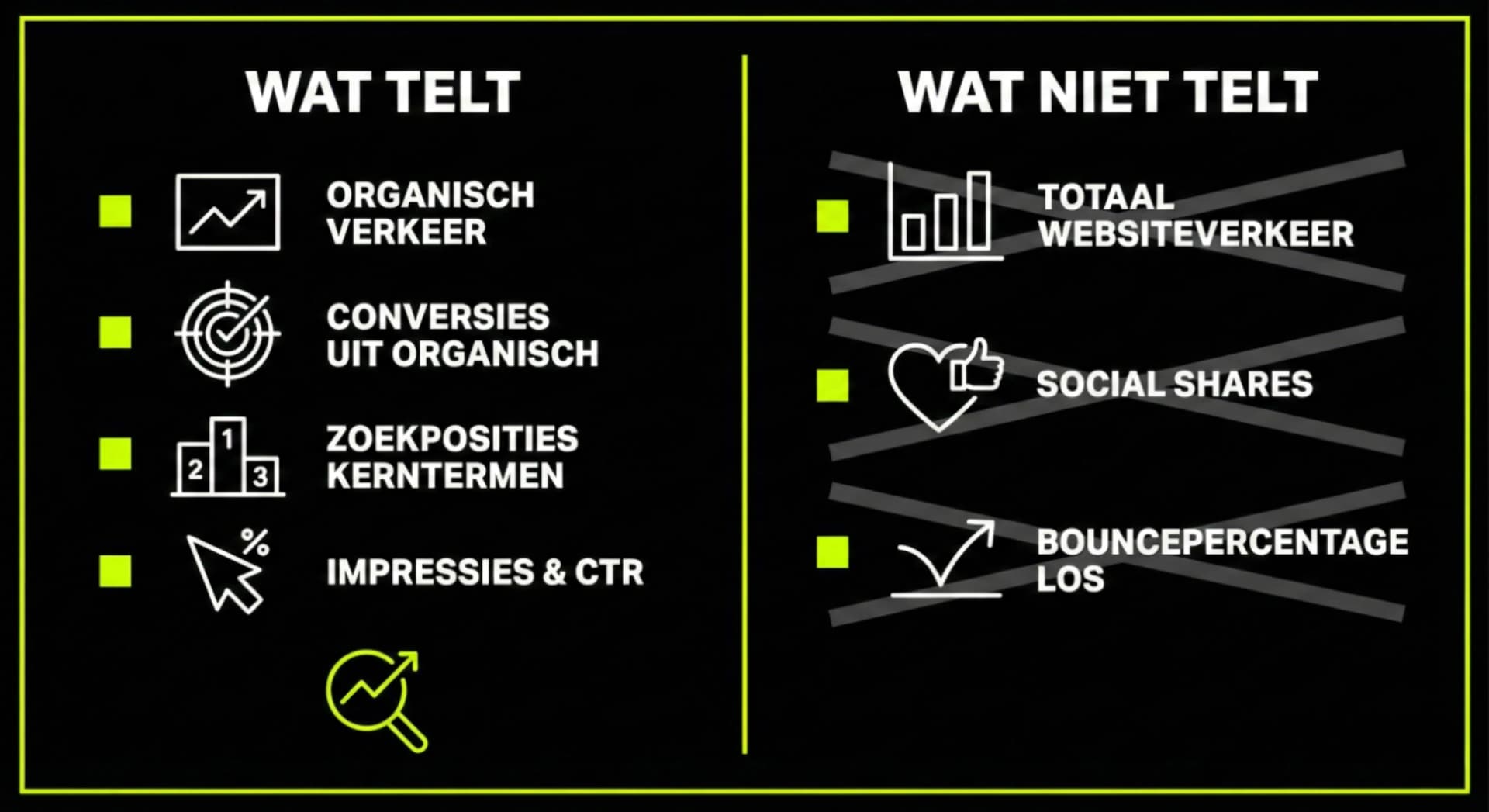
Many business owners look at the wrong numbers. Total website traffic says little if most of it comes from social media or direct visitors. And a high position for a keyword nobody types in brings nothing. So ask yourself how many customers come in through Google rather than how many visitors you have.
These are the numbers that matter:
- Organic traffic. How many visitors come in through unpaid search results? This is your baseline number. Everything you do for SEO should make this number grow, consistently.
- Conversions from organic. Measure how many inquiries, quote requests or purchases come from organic traffic. This is the number that determines your revenue.
- Rankings for your core keywords. Track the 10 to 20 keywords that bring in customers. If you climb on those, it's working.
- Impressions and click-through rate (CTR). Impressions show how often Google shows you. CTR shows how often people click through. If you're shown often but rarely clicked, your title and description could be better: the title and the short snippet Google shows with your link.
The most important instrument for this is Google Search Console. It's free and shows data straight from Google on how your site performs in the search results. Combine that with Google Analytics for conversion data, and you have a complete picture. Want to see right away how your site scores? Test it with the SEO checker.
Getting started with SEO yourself
You can do the basics yourself. With these five steps you can start today:
- Check your website. Use the free SEO checker to see where your site stands right now.
- Claim your Google Business Profile. It's free, and without that profile you won't show up in Google Maps. Fill it in completely with photos, opening hours and a good description.
- Make sure your site loads fast. Test your speed with the website speed test. On a slow page, visitors drop off before they've seen anything.
- Answer your customers' questions. Write pages that each answer one question from your customer, in the words your customer uses themselves.
- Measure what you do. Set up Google Search Console. It's free, and it shows you which keywords you're found on and how often people click.
You can handle a lot yourself. But at some point you need specialist help: for a competitor analysis, a technical audit, or an ongoing SEO engagement.
Why the platform under your website matters
A subject that rarely comes up in “what is SEO” articles, but makes a big difference: the platform your website runs on. Most small and mid-sized business websites run on WordPress, and that works fine for many businesses. If you get serious about SEO, you sometimes run into limitations. Plugins that conflict, slow load times you try to fix with caching, and technical SEO settings scattered across three different plugins.
More technical control helps: deciding exactly how Google sees your pages, how your sitemap is generated, how canonical tags are set and how you build structured data per page. That control comes with a downside: if you set it up wrong, you only notice once the damage is done. A wrong canonical tag can make Google index the wrong page. A mistake in your robots.txt can make your whole site invisible. And if content is loaded only through JavaScript instead of server-side, Google sometimes simply can't find it. Such pages get stuck on the status “Discovered, currently not indexed”: Google knows the page exists, but hasn't gotten around to reading its content. Problems like this surface when you measure, and then you can fix them in a targeted way.
My own website runs on Next.js, because it gives me full control over technical SEO. I know the pitfalls from experience, for example with canonical tags, with generating sitemaps and with the way Google renders JavaScript pages. Curious about the technical side? Read how and why I switched from WordPress to Next.js.
SEO for your industry
How SEO plays out differs per industry. The competition, the search behavior and the best approach are different for a dentist than for an online store. Below is a separate guide per industry:
Frequently asked questions about SEO
How long does it take before SEO delivers results?
Count on at least 3 to 6 months for lasting results. With little competition it can go faster, with competitive keywords it takes longer. What you build keeps counting afterward, so the results add up.
What does SEO cost?
At Vizibly, SEO engagements start from €800 a month. The investment depends on your industry, your competition and your ambitions. See the pricing page for a full overview.
Is SEO still relevant with AI?
Yes. AI changes how people search, but most ChatGPT users still use Google too. And an AI summary takes its answer from websites, so a page that answers the question well has a chance in both. Read more in the article why SEO is more relevant than ever.
Can I do SEO myself?
Yes, absolutely. Much of the basics can be learned and carried out if you make time for it. But don't underestimate it: SEO is a craft with many details. I regularly see business owners who get started enthusiastically but make the wrong choice on small points. A wrong canonical setting, content that just misses the mark, or a technical problem that is invisible but holds back your rankings. That kind of mistake is hard to spot if you don't work with it every day, and it can wipe out months of effort. So you can absolutely do it yourself, but be realistic: it takes more time and effort than you expect beforehand.
What is the difference between SEO and SEA?
SEO (organic) brings in lasting traffic that grows over time. SEA (Google Ads) delivers results right away, but stops as soon as you stop paying. Both have their place, and the best results come from a combination.
What is local SEO?
Local SEO focuses on findability in a specific area. Think Google Maps, your Google Business Profile and local search results. Especially important if your customers come from your own area.
How to get started with your own site
Use the free SEO checker and see right away how your website scores. Or get in touch for a no-obligation call about your own site.
CHECK YOUR SEO