GEO: GENERATIVE ENGINE OPTIMIZATION
Generative engine optimization: the future of SEO is GEO
Besides Google, millions of people now also put their questions to ChatGPT, Claude and Perplexity. In this article you'll read how to stay visible in both.

Google remains the most important search engine for now. Still, people increasingly type their question into ChatGPT, Claude, Deepseek, Gemini or Perplexity and read an answer right away. Then you want your business to be in that answer.
That's what GEO is about: generative engine optimization. Put simply: getting found by AI on top of your existing SEO strategy. I get more and more questions about it, so below I lay out what you need to know.
What is GEO?
GEO builds on SEO. The difference is in what someone gets to see: Google shows a list of links, with your website hopefully at the top, and an AI tool gives an answer right away. That user often doesn't even see your page or your meta description.
The AI puts that answer together from content that is online somewhere. If your content is part of it and the AI finds it reliable, it mentions you.
How far the shift has already come
The shift is already underway. A few signs:
- More and more people, especially young people, put their question to an AI tool first
- According to OpenAI, more than 800 million people were already using ChatGPT every week in October 2025
- An AI answer gives you in one go what you would otherwise piece together from a few search results
How does an AI think?
An AI like ChatGPT or Claude chooses its sources differently from Google. It looks for the best-supported answer to the question and pays attention to a few things:
- Context counts: it has to be clear who you are and what you know about, with proof to back it up.
- Structure matters a lot: an AI finds it easier to pull an answer from a text with a clear structure and good headings.
- Citations help: if others link to you or mention you, your chances go up.
- Factual accuracy: an AI tool wants to pass on reliable information and checks your content against other sources.
- Freshness: recent information often gets priority over an outdated page.
So stuffing keywords into your text isn't enough. Write your story so that an AI can understand it and pass it on.
What does that mean for your business?
If you want to stay visible, an AI tool has to be able to read your content and find it reliable. That takes five adjustments:
1. Build authority
An AI tool checks whether you demonstrably know your field. It sees that from things like:
- In-depth pages that also answer difficult questions
- Publishing regularly about the same field
- Mentions on other authoritative sites in your industry
2. Change your structure
An AI has to be able to read your text and quote a piece of it. That works better with:
- Headings and subheadings that say what is underneath
- A direct answer to every question you cover
- Formatting that makes facts stand out, such as tables and lists
- A logical structure that an AI can follow and retell
3. Share unique knowledge
An AI is more likely to name a source that adds something that isn't found elsewhere. Think of:
- Your own research and your own numbers
- Case studies with measurable results
- Examples from your own work that show how your approach plays out
- Your own opinion and experience from your field
4. Write for a conversation
With an AI tool you talk the way you would with a person: you ask a question, and then another. Your content fits that better with:
- Answers to the follow-up questions a reader probably has
- A tone like the one you would use explaining it in person
- A next step that follows logically from your answer
5. Get your technical SEO in order
The technical side of your website counts too:
- Add structured data in JSON-LD, a piece of code that tells search engines and AI tools what is on your page
- Make sure your pages load fast, so an AI crawler can read them without a hitch
- Use HTML that says what something is, such as a real heading or a real list
- Account for longer questions in plain spoken language, because that is how people search in an AI tool
Example: the same CRM text, rewritten for GEO
TRADITIONAL SEO APPROACH
"Our CRM system is the best for small and mid-sized businesses. We offer countless features, excellent support and competitive prices. Contact us for a demo."
REWRITTEN FOR GEO
"Our research among 500 small and mid-sized businesses shows that users of our CRM spend on average 27% less time on administration. The top 3 reasons: automatic customer segmentation, integrated invoicing and an intuitive interface (94% user satisfaction)."
Five steps to take now
If you want to start with GEO right away, these are the first steps:
- 1Go through your existing pages: which questions do they answer, and do they show that you know what you're talking about?
- 2Find the gaps: which questions in your field do you not have an answer to yet?
- 3Rewrite your most important pages: start with the pages that already perform best and give them the structure from this article.
- 4Measure in AI tools too: besides your clicks and rankings in Google, keep track of how often an AI answer mentions you.
- 5Try it yourself: put your customers' questions to a few different AI tools and see whether your business is in the answer.
Where search is heading
I expect this to play out in the coming years:
- AI tools will show more clearly where their answer comes from
- People will use Google and AI tools side by side, depending on their question
- New ways of measuring how visible you are in all those places will appear
- Pages with their own knowledge and experience will be cited more often than text that says the same thing everywhere
If you write your content for Google and for AI tools now, you'll be ahead of competitors who wait.
Your existing SEO copy counts for AI too
A lot of what you already put into good SEO copy helps in AI tools too. They read the same pages.
With a few targeted adjustments you raise the chance that your business also shows up in the answer from ChatGPT, Claude or Gemini.
Want to know whether AI tools already mention your business? Get in touch. Then I'll go over with you how your website is doing in Google and in AI answers.
Read more
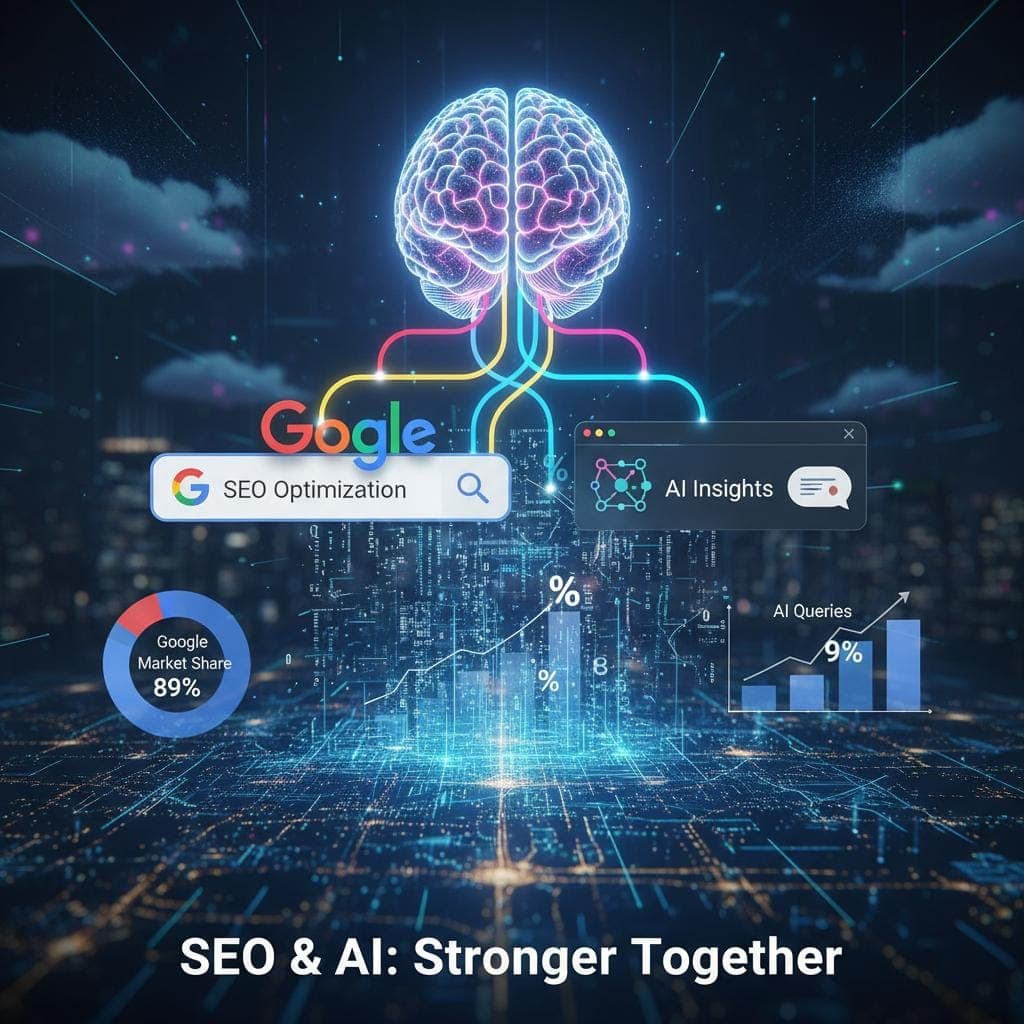
Many business owners wonder whether SEO still makes sense now that AI is growing so fast. Here is why it still pays off.
READ ARTICLE
Google published MUVERA, a multi-vector search technology that analyzes content semantically. What does it mean for your website?
READ ARTICLE
An SEO strategy decides where your time and budget in Google go. How to choose your keywords, build rankings step by step and measure what it brings in.
READ ARTICLEGet found in AI answers too
I make sure your website is built so that Google and AI tools can read it well.