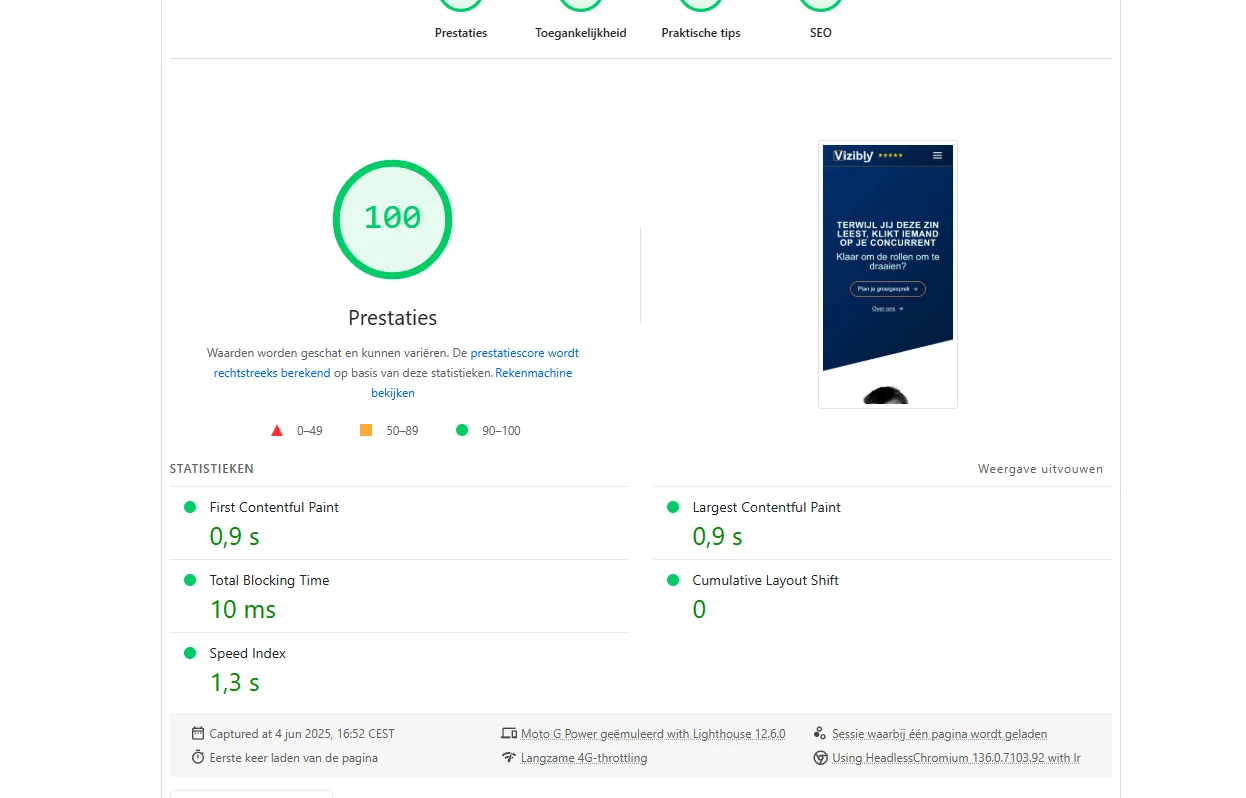
Is a perfect score of 100 on Google PageSpeed Insights really that important? I explain what that number measures, and why the speed behind it says more about your business than the score itself. (And yes, Vizibly happens to score 100/100 on mobile and desktop itself. I'll come back to that later.)
What a score of 100 does and doesn't prove
Many website owners and developers fixate on that one number. A 100 in Google PageSpeed Insights feels like proof that your site is technically in perfect shape. But that score doesn't prove it.
Google intends PageSpeed Insights as a tool: it shows you what you can improve on your site. A page can score 100 and still feel clumsy or empty to visitors. Conversely, some sites without a 100/100 load blazingly fast in real life.
So look above all at what is behind the score. A 100 isn't necessary. The load time itself does have a measurable effect on what your site delivers.
What speed does to your conversion
Your visitors never see your PageSpeed score. They only notice whether the page opens fast and responds right away when they tap something. You see that in your conversion: the share of your visitors who buy something or get in touch.
According to HubSpot, a B2B website that loads in 1 second has a conversion rate 3x higher than a website that needs 5 seconds. For online stores, the same article cites a difference of 2.5 times. Research by Bidnamic arrives at 17% more conversion for every second faster a site loads.
According to an overview by WP Rocket, 47% of consumers expect a website to load within 2 seconds, and 40% leave if it takes longer than 3 seconds. Anyone who sees nothing in those first seconds goes back to Google and clicks another result.
What you give up for a perfect score
Of the 100 most visited websites, only 34% pass the Core Web Vitals: the three measurements Google uses to judge load time, responsiveness and shifting elements. That doesn't mean the other 66% are bad sites. Often there is a deliberate choice behind it, where features visitors use matter more than a perfect score.
A perfect PageSpeed score can mean that things you actually need have been taken off the site. Think of tracking for your marketing, a chatbot for customer questions or large product photos. They all push your score down, while they do bring something to your visitors or to you.
What matters are the recommendations PageSpeed Insights puts below the score. A site with 85/100 where the important improvements have been made can do better than a bare site with 100/100.
How Vizibly reached a perfect PageSpeed score on mobile
Fast and fully featured go together just fine. Vizibly.nl scores 100/100 in Google PageSpeed Insights, with free tools on it and all Core Web Vitals in the green. This is how I did it.
Clean code and light images
I built the site on clean code, without scripts that are just dead weight. Where possible, scripts load asynchronously, so the page doesn't have to wait for them. Images are converted to light, modern formats like WebP, and pages are cached, so the server doesn't have to build them from scratch on every visit. You can read more about the technical approach on the technical SEO page.
What is deliberately not on it
I deliberately didn't add every possible feature. The site has to tell visitors what I do and make it easy for them to get in touch. Frills that don't contribute to that and make the site slower, I left out.
The measurements: the first content appears after 0.9 seconds (First Contentful Paint), nothing shifts while loading (no layout shifts) and the Total Blocking Time is 10 milliseconds, so the page responds almost instantly to a click. More important to me: the site also brings in real inquiries.
How much speed counts in Google
Google has confirmed that the Core Web Vitals count toward your position in the search results, although Google itself adds that relevant content carries more weight. So speed mainly makes the difference in markets where several sites have about equally good content.
Of all the signals Google uses, the Core Web Vitals are the easiest to check. In Search Console and PageSpeed Insights you see the same measurement data Google uses to judge your site. You can see right there which pages are slower than the rest.
How fast your site needs to be
Fast enough for your visitors and for what you want to achieve with your site. That is the measure. Your visitors can't see whether PageSpeed Insights says 90 or 100.
For an online store, load time matters even more, because every visitor who drops off costs revenue right away. A visitor who clicks away before the product page appears never sees your offer.
How I handle speed on client sites
I optimize for what your visitors notice. The 100 on my own site isn't a goal in itself, but it is proof that I can build sites that are fast and also sell.
On a client site, I weigh the technology against what the site has to do. Sometimes I accept a 95, because otherwise a feature the client needs would have to go. Other times the site simply hits 100, without anything having to come out.
In the end your site has to turn visitors into customers, without anyone staring at a loading bar. That is why speed is a fixed part of my SEO strategy, alongside good content and a site Google can read easily.
Measure the load time of your site
Test it yourself with the free speed test. Or get in touch, and I'll find out what is slowing your site down and what you can do about it.
Call: +31 6 282 064 10. Or schedule a call.