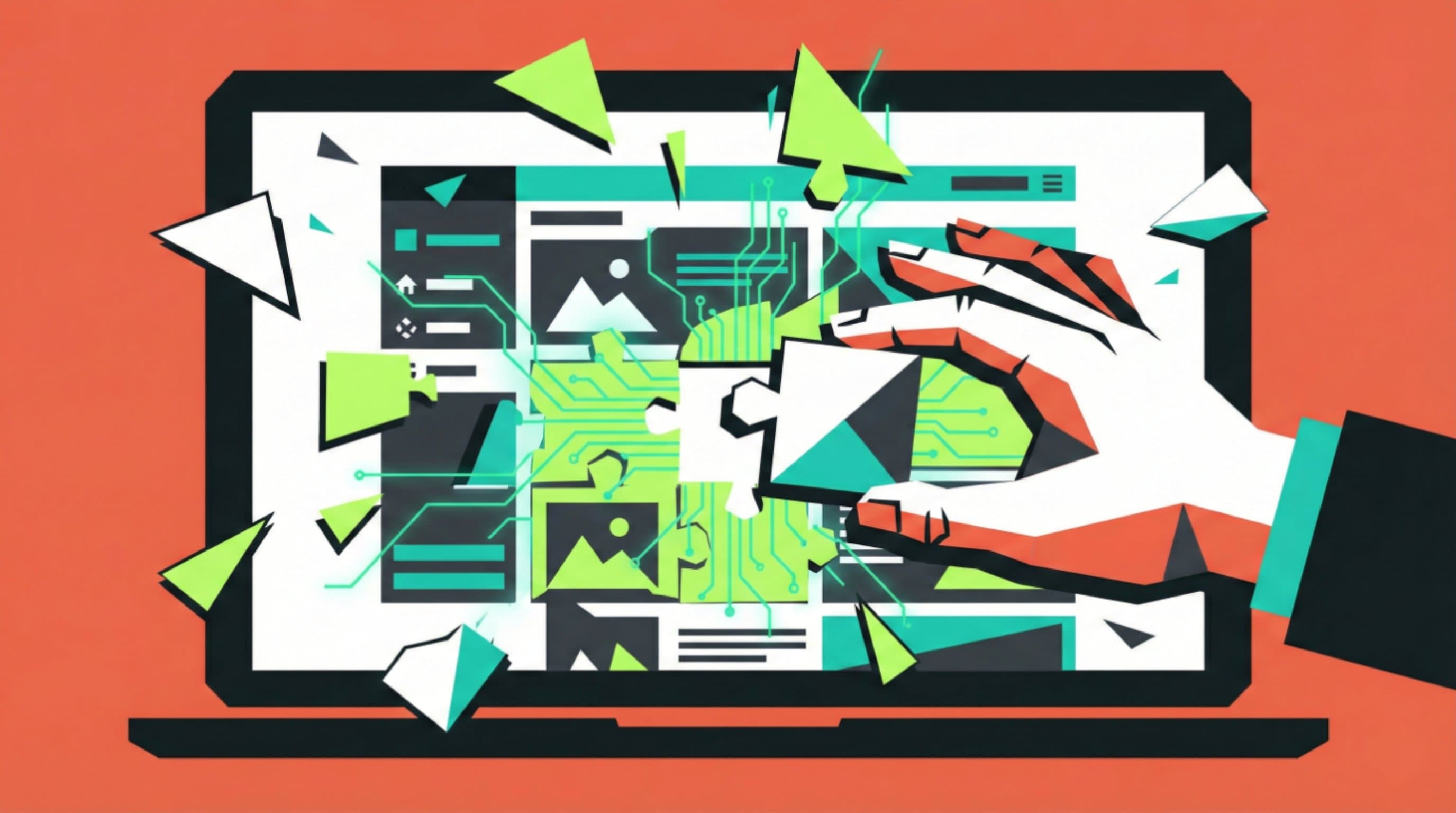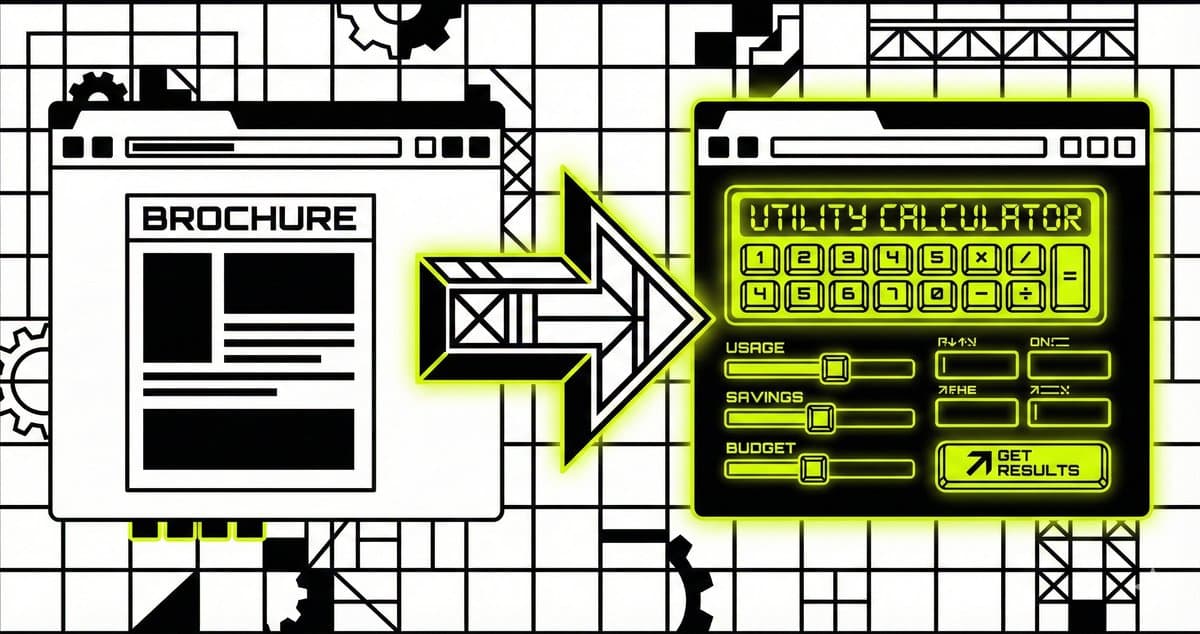
At Independer (a Dutch comparison site) you calculate your mortgage for free, at Nibud (a Dutch personal finance institute) your budget, and at Coolblue (a Dutch online retailer) a product finder helps you choose. None of those tools tries to sell you something right away. They answer a question you already had, and when you later want to buy or sign up for something, you know where to go. That approach is called utility marketing. For a long time it was something for businesses with big budgets. With AI, a tool like that is now affordable for a smaller business too.
What is utility marketing?
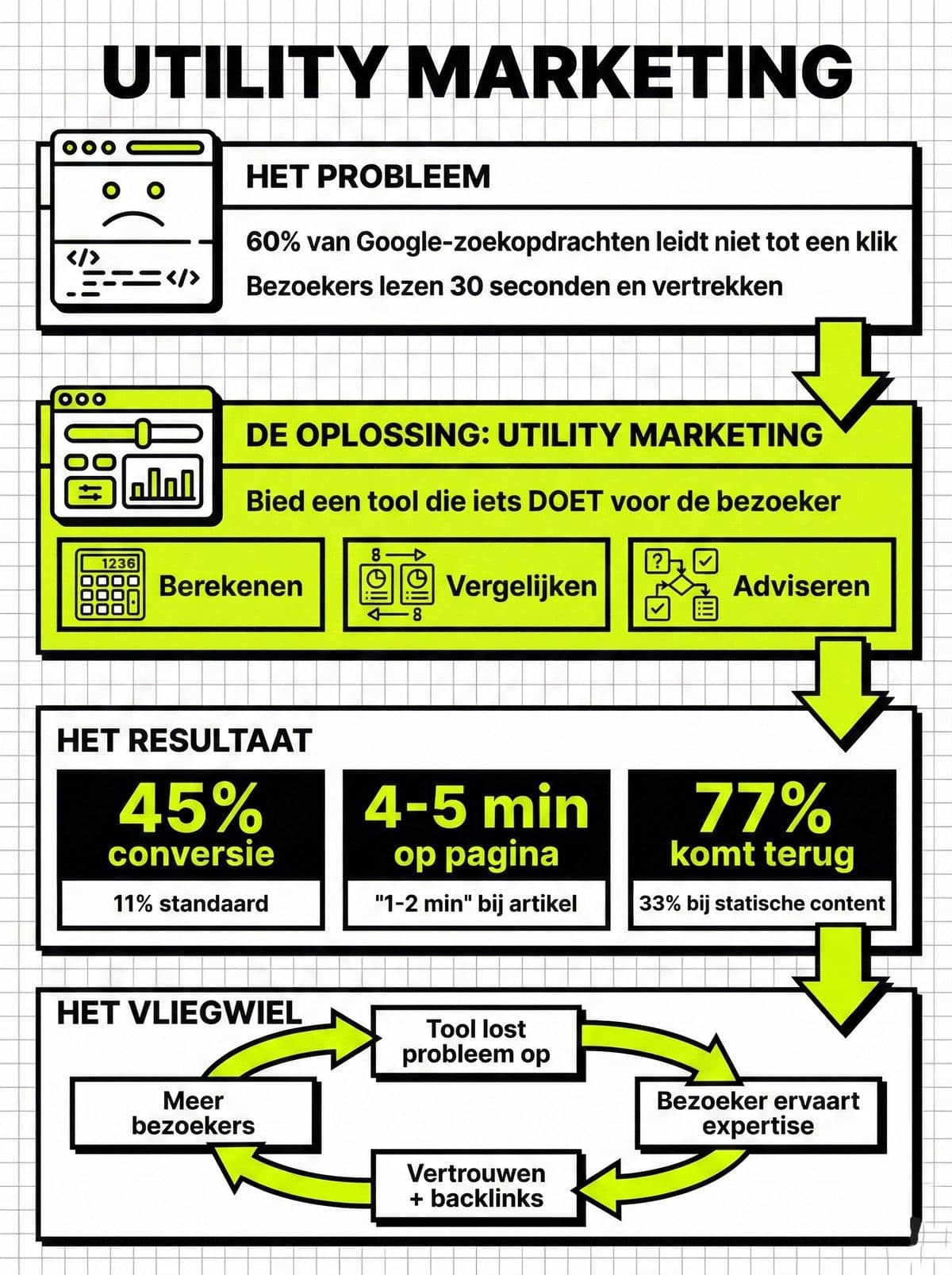
Utility marketing means helping customers with something they can use right away, like a calculator that works out an amount, a comparison tool that puts options side by side or a product finder that recommends a product. The visitor gets something out of it immediately. You get their attention, and if the tool is good, their trust too and maybe their business later.
It looks like content marketing, but the difference is in what the visitor does. You read an article about mortgage rates and forget it again. You fill in a tool that calculates your maximum mortgage yourself, and the amount that comes out is about your situation. That sticks better.
Why it works
A good tool doesn't feel like advertising. You calculate your mortgage or have a product recommended because it's useful to you, and nobody tries to push something on you in the meantime. That makes you more open to it than to an ad.
Well-known examples of utility marketing
It's not new. The best-known examples have been running for years, and you've probably used a few of them yourself.
Independer started as a comparison site and grew into a place where many Dutch people calculate their mortgage (in Dutch), compare insurance and sign up for energy contracts. All those tools are free. Independer only earns money when you switch after comparing, because then it gets a commission.
BerekenHet.nl (in Dutch) goes even further: the whole site consists of calculators, for your mortgage, your taxes, saving and pensions, among other things. The counter on the homepage shows more than three hundred, and they're all free. People who come there want to work something out.
Nibud has dozens of free calculators (in Dutch) that let you keep track of your budget, calculate your mortgage or estimate your purchasing power. Nobody thinks of marketing when they think of Nibud, yet those tools do exactly what good marketing does: they make sure you remember the name.
Outside the Netherlands, Wise is the best-known example. The company behind cheap international transfers built a free currency calculator and made a separate page of it for countless currency pairs, hundreds of thousands of pages in total. With that, Wise draws millions of visitors from Google every month. It earns nothing on the calculator itself, because the money comes from the transfers. But the calculator is the front door: someone who looks up an exchange rate lands at Wise right away.
It went the same way at HubSpot. The free Website Grader looks at your site and gives it a score from 1 to 100. Around 2010, HubSpot reported on its own blog that the tool had already graded more than two million websites, and some of those website owners later became customers of the paid software.
Look at those examples and every tool starts with a question people already had: how much can I borrow, what does that transfer cost, how is my site doing?
Why small and mid-sized businesses can start with it now too
Those examples all come from big companies, with their own development teams and big budgets. For a hair salon or an HVAC contractor, utility marketing was therefore too expensive for a long time. That has changed, for three reasons.
Building a tool costs less than it used to
Until recently, you had an agency build your own calculator or comparison tool, and that quickly ran into the thousands of euros. With AI, building goes much faster. In a GitHub study, programmers with AI help finished a task 55% faster than programmers without. Work that used to take weeks often takes days now, and you see that in the price.
Google keeps more and more searchers to itself
Google answers more and more searches directly in the search results. According to research by SparkToro from 2024, almost 60% of Google searches in the US and the EU end without a click to a website. That's called zero-click. The AI summaries Google puts at the top make that stronger, so that even first place in the regular results brings in fewer visitors. Social media platforms also prefer to keep their users in their own app. Writing a blog post and hoping for visitors from Google therefore brings in less and less.
Tools are different. Someone who searches for "hypotheek berekenen" (calculate mortgage), "BTW calculator" (VAT calculator) or "energiekosten vergelijken" (compare energy costs) wants to work something out or put options side by side. An AI summary can hardly take that over, because the searcher has to fill in their own details, like their income or their electricity use. For that, they come to a site with a tool that works.
That makes a tool one of the few kinds of content that still draws visitors to your site while Google answers more and more itself. And if the tool is good, that visitor comes back as soon as they have the same question again.
A tool simply fits into your own site
With Next.js, the technology I build my sites on, you put a tool on a regular page of your own website. In the past, something like that often ran as a separate application on its own domain. If the tool sits on your own site, your SEO benefits: the links and visitors it draws count for your whole domain.
I noticed it myself when I started building tools. First for Vizibly: an SEO checker, a website checker and a website speed test. Then for clients: a product finder for coffee machines, a quiz about bathroom styles and a DPP tool for a compliance consultancy. The difference from a blog post or guest post is big. Everyone gets excited about a tool: clients, people who are still on the fence, even my accountant. A tool is tangible: you can show it and use it.
What utility marketing brings in
The research firm Demand Metric asked marketers how well their content turns visitors into customers. People who used interactive content, like calculators, were clearly more likely to be satisfied with it than people who only made articles and videos.
The British lingerie label Nudea shows how that works in an online store. The brand has a short fit test that gives you your size, and according to Nudea itself, women who fill in the test buy more often and return less.
Exactly how much it brings in differs per industry, and a tool nobody needs brings in nothing. If the tool does answer a real question from your customer, your visitor has a reason to stay and fill something in.
After a tool, getting in touch is a smaller step. A visitor who has already calculated their mortgage or their size knows what they need. For someone who only read a page, calling or emailing is a bigger step.
What a tool does for your findability
A good tool can move your SEO forward too, and that happens in a few ways.
A handy tool often gets backlinks on its own: other sites point to it and people pass it on. You see that with Wise's currency calculator, which countless sites link to. You don't have to ask anyone for links like that.
People who fill something in or calculate something stay on your page longer than people who just read for a moment. Google doesn't say how heavily it weighs behavior like that. A page where people actively do something does at least show that they found what they were looking for.
In time, people search for your tool with your name attached, like “Independer hypotheek berekenen” (Independer calculate mortgage) or “Nibud budgettest” (Nibud budget test). Searches like that with your brand name show Google that people know you and want to find you specifically.
Then there's AI. ChatGPT and Perplexity base their answers on what they find on the web, and sites that rank well and get mentioned often have a better chance of being recommended by AI. A tool that gets linked to a lot helps you in those answers too.
How to start on your first tool
Start with the question your customers keep asking you. How much does this cost? Which one suits me? What do I need? If you notice you keep making the same calculation or giving the same explanation, you have your starting point.
For a mortgage advisor, that's a calculation of the maximum mortgage, for an accountant a VAT calculator and for a dentist a tool that gives an indication of the costs. A tool like that can stay simple as long as it answers exactly your customer's question.
Technically, it doesn't have to be a hurdle. A well-built website can simply carry a tool like that, and with AI, building goes faster than it did a few years ago. In my article on micro-tools I describe step by step how to have a tool like that built, with costs and examples.
A calculator or product finder on your own site
I build websites on Next.js where you can add a calculator or product finder without hassle. Tell me which question your customers keep asking you, and I'll help you come up with a tool that answers it. Call: +31 6 282 064 10. Or schedule a call.
SCHEDULE A CALL