
Someone looking for a new dentist types something like “tandarts bij mij in de buurt” (dentist near me) into Google and picks from the practices at the top. In this article, I show what you can do as a dentist to get there and win more patients.
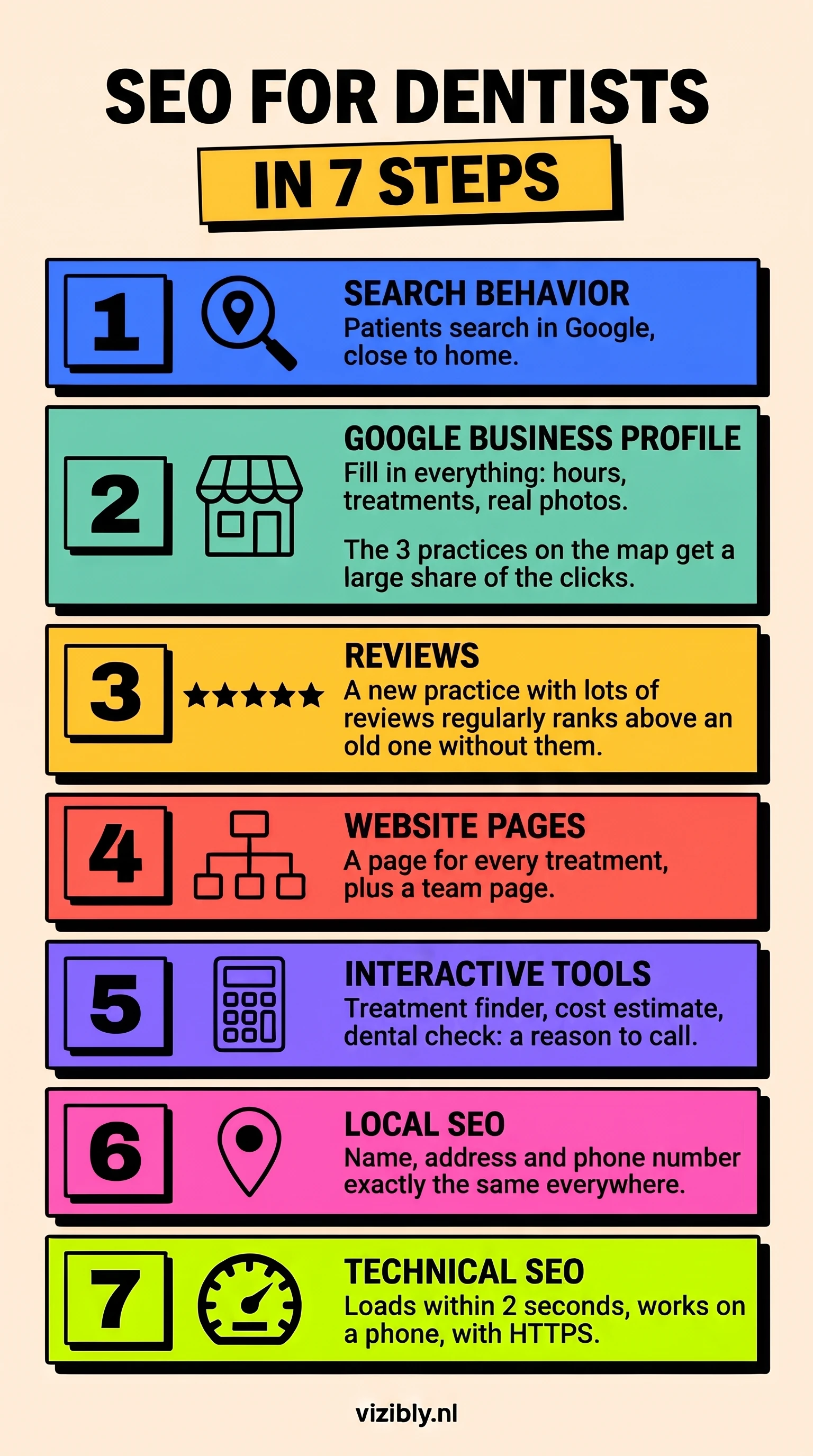
How patients search for a dentist in 2026
The trigger differs from patient to patient: a move, dissatisfaction with the current dentist, or a treatment that calls for a specialist. The search usually starts in the same place, Google, and most people don't look past the first page of results.
More and more people also put their health questions to AI tools like ChatGPT, Gemini and Perplexity. To answer, such a tool first searches the internet itself, often with a handful of sub-questions at once (this is called “query fan-out”), and bases its recommendation on what it finds. Pages that rank well in Google therefore also end up in those answers more often.
This search behavior is also very local: someone searches “tandarts Amsterdam Oost” (dentist Amsterdam East) or “implantoloog Rotterdam” (implantologist Rotterdam). Your competitors are the practices in your own neighborhood or city, and there are usually only a handful of them. That is why local SEO pays off for dentists: the pond is small, and the practice at the top is the first practice a new patient sees.
YMYL: Google counts dental content as “Your Money or Your Life”: topics that affect your health or your money. Pages like that are judged more strictly on reliability and expertise, so a professional website with good content carries extra weight for a dentist.
Setting up your Google Business Profile properly
When someone googles “tandarts bij mij in de buurt” (dentist near me), Google shows a map at the top with three practices (the Local Pack), with their address, reviews, opening hours and a link to the website. Those three get a large share of the clicks, and with that a large share of the phone calls. Whether your practice is among them depends mostly on your Google Business Profile.
Fill in everything: name, address, phone number, opening hours and website, but also which treatments you offer, which insurers you accept and whether you take new patients. The more complete the profile, the better Google rates it. Choose “Dentist” as the primary category and add subcategories for specializations: “Orthodontist”, “Implantologist”, “Cosmetic dentist”, “Pediatric dentist”.
Upload real photos of your practice, treatment rooms, team and waiting room. A profile with plenty of real photos builds trust and invites clicks. Also post an update regularly, such as a new treatment, changed opening hours or a new colleague. That shows Google your profile is active.
Collecting and answering Google reviews
Reviews carry a lot of weight for that map with three practices. A fairly new practice with lots of positive reviews regularly ranks above a practice that has been around for twenty years and has hardly any. For the patient they count just as much: a high average with recent reviews gives them the confidence to call.
Collecting reviews doesn't have to be complicated. Ask for one after a good treatment, with a short WhatsApp message or email that links straight to your review page in Google. Plenty of people will write a review if you make it easy for them.
Respond to every review, including the negative ones. A calm, professional reply to a complaint shows new patients how you handle criticism.
What your dental website needs to do
Many dental sites look alike: a stock photo of a smiling woman, a list of treatments and a contact form somewhere. That doesn't make you stand out, while your website is the first thing a new patient sees of your practice after the search results.
A well-built website loads within 2 seconds and works well on a phone. With a website for a healthcare practice, trust matters even more, because someone with a toothache chooses on instinct and within a few seconds. Your site has to reassure that visitor and make the step to an appointment as small as possible.
Which pages you need
Every treatment you offer gets its own page with an explanation in plain language, such as “Implantaten tandarts Amsterdam” (dental implants dentist Amsterdam), “Wortelkanaalbehandeling Utrecht” (root canal treatment Utrecht) or “Orthodontie Den Haag” (orthodontics The Hague). Those are exactly the kinds of terms patients search for.
The basis is a homepage that shows who you are, where you are and what you do, with a direct way to make an appointment. On every treatment page, you answer the questions a patient has: what is it, how does it work, how long does it take and roughly what does it cost. A team page with photos and short bios belongs too, because patients want to know who they will meet in the chair. And make getting in touch as easy as possible, with a phone number you can tap on mobile, online appointment booking and directions via Google Maps.
Interactive tools on your website
An average dental site only gives information. With small, interactive tools, you give visitors a reason to stay and get in touch. I wrote about this at length earlier in my article on micro-tools.
Which tools suit a dental practice?
- Treatment finder. A short questionnaire: “What's bothering you?” Based on the answers, the visitor sees which treatment fits and roughly what it costs, and can book an appointment right away.
- Cost estimate calculator. Patients want to know what something costs. A simple tool that gives an estimate based on treatment and insurance takes that uncertainty away.
- Dental check. A visual tool that lets visitors assess their teeth. A check like that is easy to try and easy to share on social media, which brings people to your site you wouldn't have reached otherwise.
- Online appointment planner. Your visitor picks a free slot in the practice's calendar right away and doesn't have to wait days for a reply to their email.
Of all the visitors on a dental site, only a small share actually makes an appointment. An interactive tool gives a visitor an answer right away, and with that a reason to call. That matters, because it takes a lot of effort to get visitors to your site at all.
Tools like these used to be expensive and hard to build, but AI has changed that. I now include them as standard in every website, so a visitor can do something with them right away.
Keywords for dentists
In keyword research for dentists, I look at three kinds of search terms, and each kind brings a different type of patient.
Local search terms
This is the most important group: “tandarts [stad]” (dentist [city]), “tandarts [wijk]” (dentist [neighborhood]), “tandarts in de buurt” (dentist nearby). Not a huge number of people search for each term, but people who search like this want to make an appointment.
Search terms per treatment
“Kosten kroon tandarts” (cost of a crown at the dentist), “implantaten prijs” (implants price), “onzichtbare beugel volwassenen” (invisible braces adults), “tanden bleken Rotterdam” (teeth whitening Rotterdam). People who search specifically for a treatment are often further along in their decision process. They are comparing options and practices.
Patient questions
“Pijn na wortelkanaalbehandeling normaal?” (pain after root canal treatment normal?), “wanneer naar de tandarts met kiespijn” (when to see the dentist with a toothache), “verschil tussen kroon en brug” (difference between crown and bridge). Someone who searches like this may not become a patient right away. With good content, though, they land on your site, and if they need a treatment later, they already know your practice.
Tip: combine keywords with a location
Target your implants page at “Implantaten tandarts [jouw stad]” (dental implants dentist [your city]) instead of just “implantaten” (implants). That way Google understands which place you are relevant for. Do this for every treatment you offer.
Blogging about treatments and frequently asked questions
Google likes to show pages that give useful, reliable information, and many dental practices still do little with that. With a blog that answers frequently asked questions, you draw people to your site who have a question about their teeth.
- “Hoe vaak moet je naar de tandarts?” (How often should you go to the dentist?) Many people search for this. A clear answer brings them to your site and shows that your practice is approachable.
- “Wat kost een kroon bij de tandarts?” (What does a crown cost at the dentist?) Give estimates, mention that the price differs per situation and invite readers to a consultation. People who know roughly what it costs find it easier to call.
- “Bang voor de tandarts? Dit kan je helpen.” (Afraid of the dentist? This can help.) Fear of the dentist is common. An article about it attracts patients who are looking for a reassuring practice.
- “Wanneer heeft mijn kind een beugel nodig?” (When does my child need braces?) Parents actively search for this. If you answer the question clearly, they already know your practice before they walk in.
Write for patients, without jargon, and explain as if you were telling a friend. With dental content, Google pays extra attention to experience, expertise, authoritativeness and trustworthiness (together called E-E-A-T), so also show which dentist wrote or reviewed the text.
Strengthening your local findability
Local SEO is the most important part of the online strategy for dentists. You want to be found by people in your city or neighborhood. Besides your Google Business Profile and local keywords, a few extra things help.
Start with your name, address and phone number (together called NAP). These must be exactly the same everywhere: on your website, in Google, on ZorgkaartNederland (a Dutch review site for healthcare providers), on tandarts.nl (a Dutch dental information site) and on social media. A single difference, like “straat” versus “str.”, can confuse Google. Also make sure your profiles on healthcare platforms like ZorgkaartNederland, tandarts.nl and independer.nl (a Dutch comparison site) are complete. Patients actively search on those sites, and Google sees them as reliable sources.
Local content helps too. If you sponsor a sports event or give talks at schools, write about it: that involvement in the neighborhood strengthens your local relevance in Google. With structured data (a piece of code that lays out your practice details for Google, such as MedicalOrganization and LocalBusiness), you make sure Google shows your address, opening hours and contact details correctly in the search results.
Finally: AI tools pull their data from various sources. ChatGPT mainly uses Bing and Foursquare, Gemini leans on Google Maps, and Perplexity draws a lot from Reddit and review sites. Make sure your practice is listed correctly and completely on all these platforms. That increases the chance that AI tools recommend you when someone asks for a “good dentist in [your city]”.
Technical SEO for dental practices
Many dental websites run on outdated WordPress templates that load slowly and don't work well on a phone. A slow site like that costs you patients, because people who have to wait click back to the search results. Google also measures your loading speed (Core Web Vitals) and factors it into the rankings.
Aim for a load time under 2 seconds and test your site with the free website speed test. Most visitors come on their phone, so your site has to work well there: readable text, no horizontal scrolling and a phone number you can tap to call.
Also make sure you have HTTPS, the padlock in the address bar. Without that padlock, a patient sees the warning “not secure,” and when it's a healthcare provider, they quickly click away. Also use the free SEO checker to see whether Google can find your pages and include them in the search results. Sometimes pages are blocked by accident, and then they show up nowhere.
Where to start as a dentist
The Netherlands has had a shortage of dentists for years. Even so, a full practice benefits from online visibility, because it lets you attract the patients for the treatments you like doing most.
Start with your Google Business Profile and your reviews, because they decide whether you appear on the map at the top. Then build a fast website with the right pages, interactive tools such as a treatment finder or cost estimate, and content that answers patients' questions. Practices that rank well in Google are also cited more often by AI tools like ChatGPT and Gemini. With a well-thought-out SEO strategy, you build a steady stream of new patients that doesn't depend on ads.
This approach isn't unique to dentists, by the way. On SEO for healthcare, you can read how the same method works out for other practices, such as general practitioners and physical therapists.
Get SEO done for your practice
Vizibly System measures every month what could be better about your findability, and I make those changes. If you would rather have a new website right away that does this well from the start, I build that too. Call me at +31 6 282 064 10 or schedule a call.
SCHEDULE A CALL