I notice it more and more in conversations: business owners who doubt SEO. They read articles about ChatGPT, see how fast AI is growing, and wonder: is it still worth investing in SEO?
My answer is yes, and I even think SEO is becoming more important.
Search is changing, and AI plays an ever bigger role. But those same AI tools pull their answers from the very search results that SEO is about. In this article I use numbers to show how that works.
Where the doubt comes from
On LinkedIn and YouTube you run into it regularly: “SEO is dead.” It often comes with advice to invest in “AI optimization” instead, because regular SEO is supposedly obsolete.
The reasoning goes roughly like this: people now ask ChatGPT, Gemini or Claude their questions and get an answer right away. Then nobody clicks on a link anymore, your website gets no visitors and SEO no longer makes sense.
That sounds logical, but the numbers show something different.
Fact 1: Google is still by far the biggest search engine
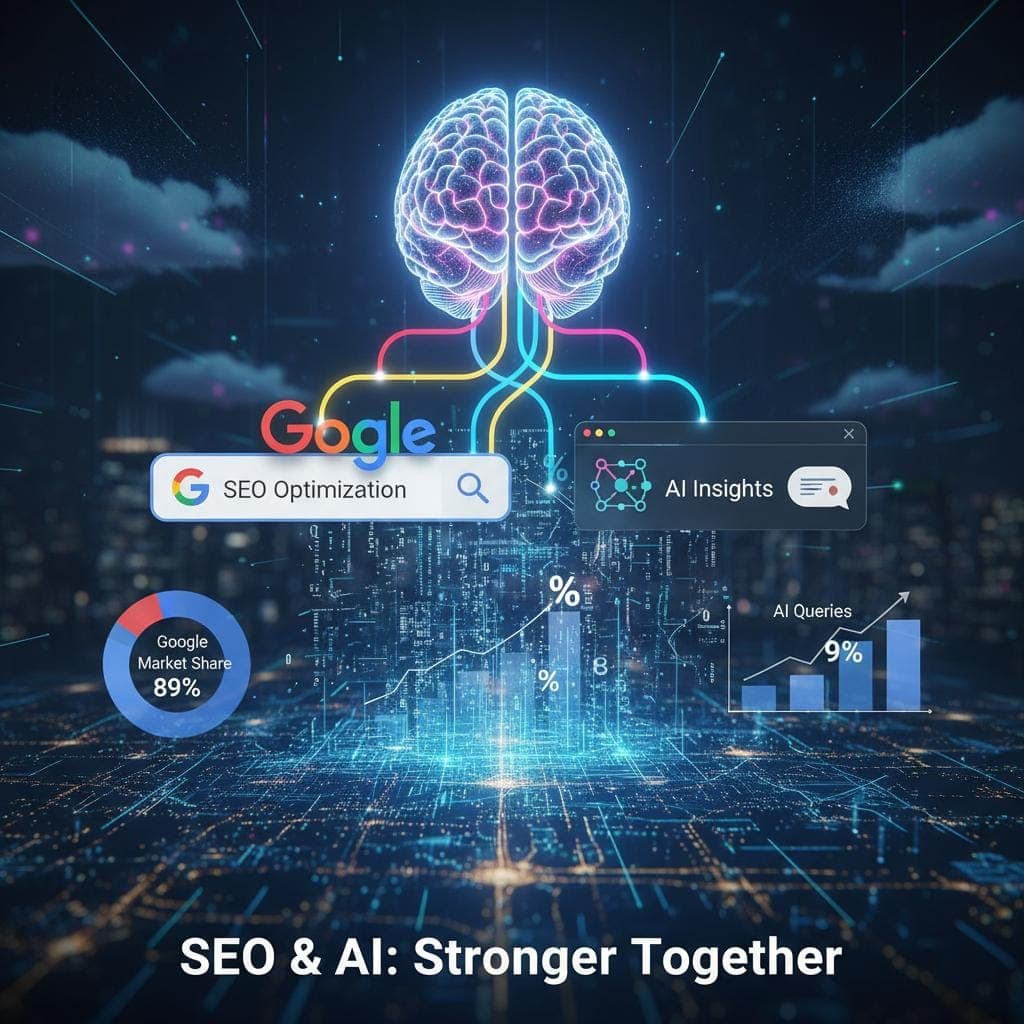
Google has a worldwide market share of 89 to 90%. That is just under 90% for the first time since 2015, and still far ahead of any other search engine.
Google handles more than 5 trillion searches a year, which works out to about 9.5 million per minute.
ChatGPT is growing fast, that's true: it now has about 9% of digital search queries. Still, in early 2025 Google got 373 times as many searches as ChatGPT.
For every search in ChatGPT, there were 373 in Google.
People who use ChatGPT often still search in Google too. People use both: Google for one thing, AI for another.
That also goes for the customers who often bring in the most. Decision-makers in companies have often worked with Google for years, and for a big purchase or a new supplier they don't simply switch to a chatbot.
Fact 2: AI tools sometimes make things up

AI tools like ChatGPT, Gemini and Perplexity sometimes make things up. In the field this is called “hallucinating”: the model gives an answer that isn't true, and delivers it just as confidently as an answer that is.
According to an overview of the best AI models, even the strongest models still hallucinate in at least 0.7% of cases, and some models in 25% or more. Notably, the newest reasoning models hallucinate more often than their predecessors: OpenAI's o3 model was at 33% in one test, and the o4-mini model even at 48%.
So better reasoning doesn't automatically mean less making things up.
That comes from the way these models work. They predict the most likely next word based on patterns, and whether that word is also correct, they don't know. OpenAI itself admits that hallucinations are therefore mathematically inevitable. So it isn't a flaw that an update will quickly remove.
For a quick question that's no disaster. If you have to choose which product to buy, which service provider to hire or what to do about a health problem, you want to know where an answer comes from.
Google shows you several sources side by side, so you can compare and judge for yourself. An AI tool gives one answer, and it sounds just as sure when it's wrong. For important decisions, that gives Google an edge.
Fact 3: AI tools get their answers from search results
To me this is the most important reason SEO isn't going away: AI tools need search engines.
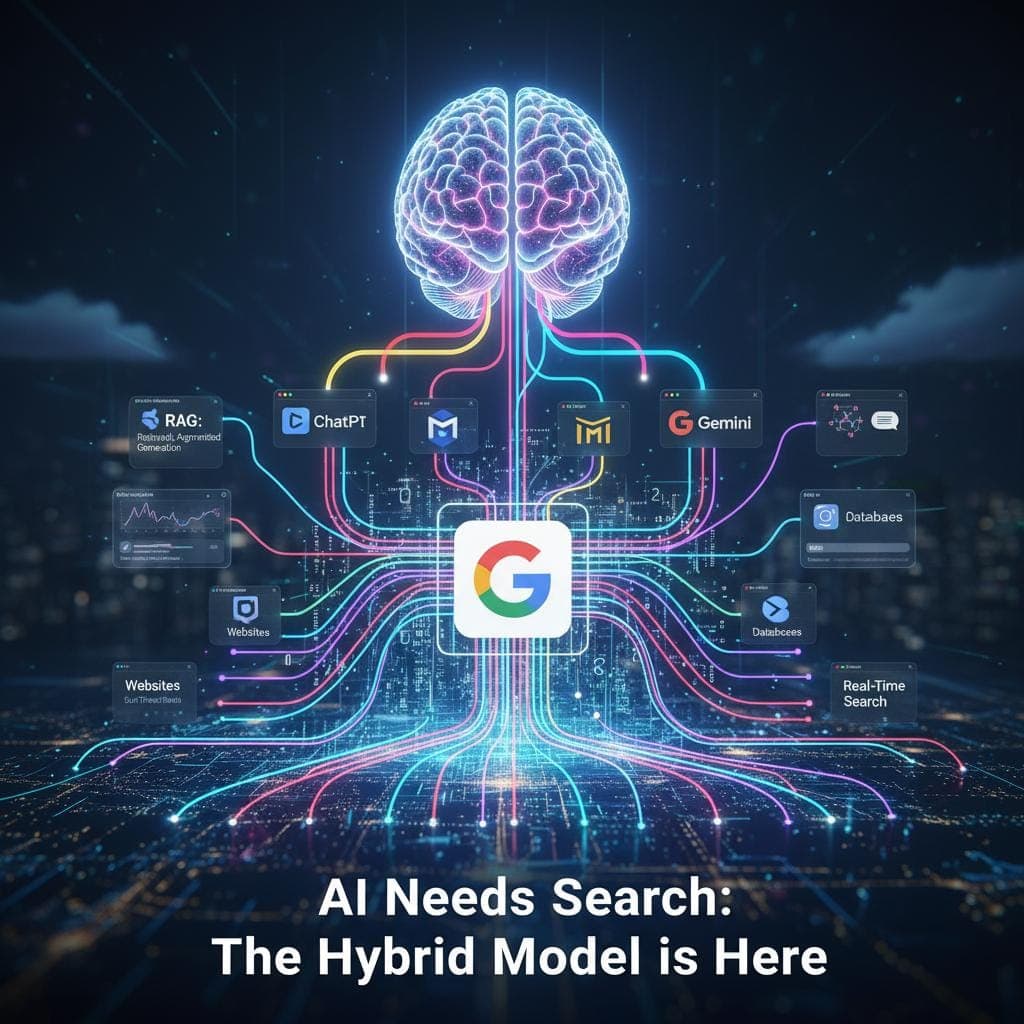
ChatGPT Search, Gemini and Claude all work with RAG, short for Retrieval-Augmented Generation. That sounds complicated, but it simply means the AI first searches the web and only then gives an answer.
Without those search results, the AI can only fall back on what the model once learned, and that quickly gets outdated.
ChatGPT Search and Gemini therefore need current access to websites. They crawl websites (scan and read them), index the content and build their answers with it.
So search and AI are already intertwined: behind many AI answers is simply a search.
AI tools name sources with their answers and link to websites. They often pick sites that are strong on what Google has valued for years: authority, expertise, trustworthiness and original content.
One study found that a website in position 1 in Google also shows up in AI search results in 25% of cases. The lower you rank in Google, the smaller the chance an AI tool names you.
So what you do for Google also counts in AI tools, and that means SEO now pays off in more places.
What this means for your SEO
The three facts side by side:
- Google is still by far the biggest search engine
- AI tools make things up too often to be trusted blindly for important decisions
- AI tools get their answers from search results and pick their sources on the same signals SEO is about
So SEO stays, it just gets broader. It used to be about being visible in Google, now it's about being visible everywhere people search. The principles are the same.
There's a name for that too: “Search Everywhere Optimization”. You then also tune your content to the way AI tools find and cite content. The basis for that looks like this:
- Original content that shows you know what you're talking about
- A clear structure that search engines (and AI) can understand
- Building authority through mentions, links and reviews
- Having the technical side in order (speed, indexability, schema markup)
What does change
Not everything stays the same, though. There are two shifts to take into account.
The first: fewer people click through to websites. In the US, the number of searches without a click rose 11% in a year, while the number of clicks on regular search results fell 9%. That is partly due to AI Overviews: Google puts the answer at the top itself, and the searcher no longer has to click through.
The clicks you do still get are often worth more. Someone who clicks through after an AI Overview like that usually already knows what they're looking for and is closer to a decision.
So with your SEO, look mostly at how many inquiries and sales your site brings in.
The second shift is in how people think about search. In one survey, 82% of consumers say searching with AI is more useful than a regular search engine, and younger users in particular are trying tools like ChatGPT, Gemini and Claude. A survey measures what people say and not what they do, so read this number as an indication.
Adjust your approach where needed. What you already did for Google keeps counting.
Where the opportunity is
Some business owners are doubting SEO. If you carry on, you face less competition in the search results.
Some companies shift their budget to paid ads or try to go viral on social media, and put SEO on the back burner.
Meanwhile Google keeps about 89% market share. If you let your SEO slide, a competitor takes your place in those search results.
If you invest in solid SEO now, with content that shows your knowledge, a technical setup that is sound and a clear story about who you are, it works in Google and increases your chance of being named in AI answers.
In the trade press, too, the advice stays the same: show who you are, make original content, build your own name in your field and share what you know. An AI tool can't take that over from you.
If you're the best source on your subject, you have a chance of being found in both Google and ChatGPT.
Where to start now
If you're starting on this, here are the five steps:
- Check where you stand now. Look at how visible you are in Google, how strong your content is and how fast your website loads. That is your starting point.
- Build authority. Write content that only you can write, because you have the knowledge, and use your own numbers, client examples and experience in it.
- Write answers to real questions. AI tools look for a specific answer to a specific question. Make sure that answer is on your site, short and clear enough to cite.
- Make it technically watertight. Speed, structured data and clear headings help Google and AI tools understand and use your content.
- Stay consistent. SEO takes time to pay off. So keep the work going, even in the months when you still see little difference.
If you start now while others are still doubting, you'll have a head start later: visibility in Google and in AI answers that you've already built up.
My conclusion
SEO is changing. It is less about optimizing individual pages for Google and more about building authority in your field.
If you do that well, it helps you in Google and just as much in ChatGPT or Gemini, wherever people search for what you offer.
So SEO still makes sense, as long as you see it as broader than just Google.
The next step is a strategy tuned to Google and AI tools at the same time.
First look at where you stand
Call me: +31 6 282 064 10. In a short call I'll go over with you how visible you are now in Google and in AI tools, and what you can tackle first.
GET IN TOUCH