As far as I'm concerned, AI is the best tool marketing has gotten in years. It only produces good work if a human reviews the result. In this article you'll read what AI can do in marketing right now, why a human always has to look at the result, and how to use AI for work you couldn't make before, without it making you lazy.
What AI makes possible now
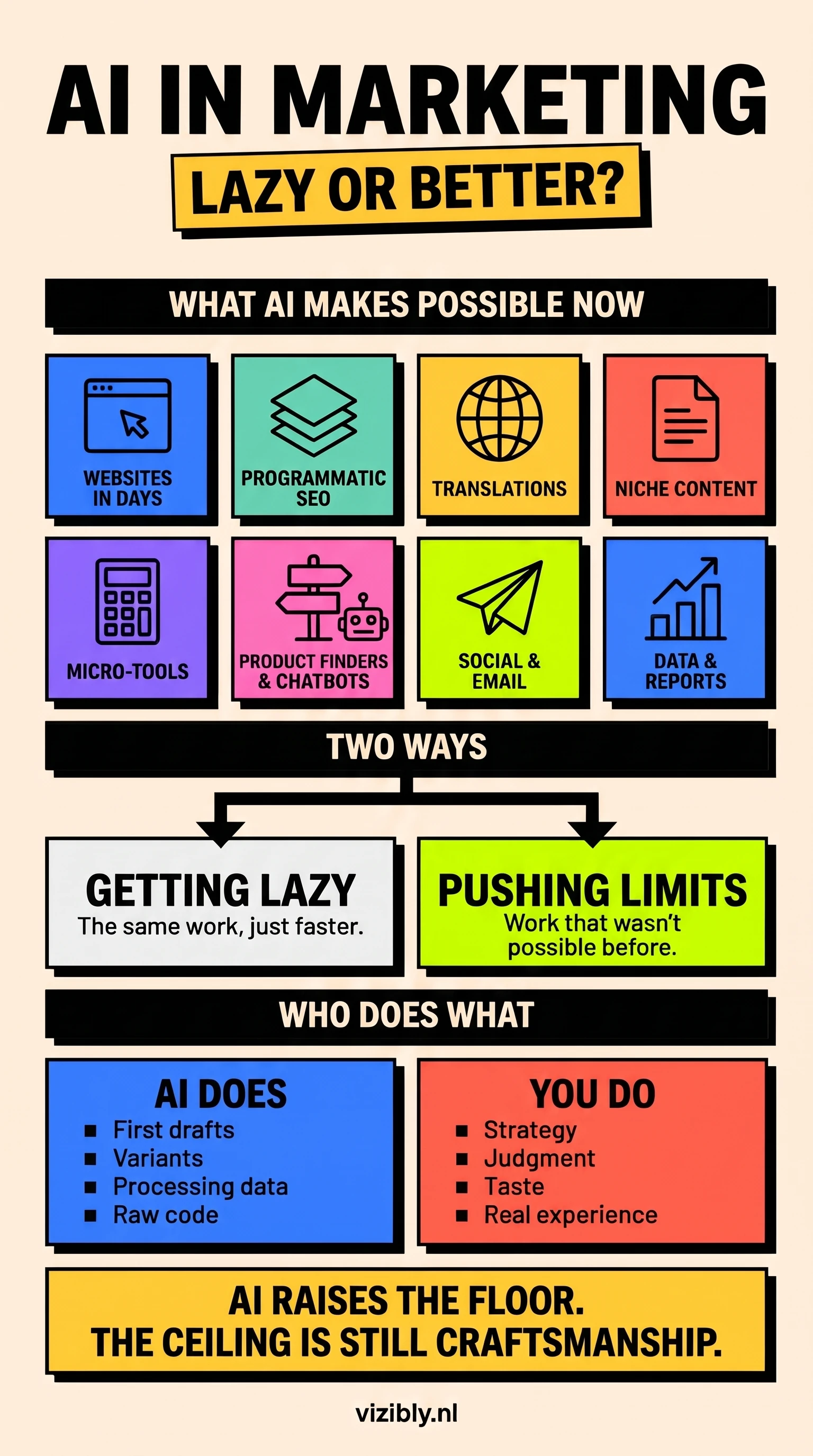
The list of things that are suddenly possible is long. A lot of work has moved in recent years from “unaffordable” or “too slow” to “I'll do that on the side”, and you can already see it in everyday work. Many marketers now use AI tools every day. Here's a selection of what I build myself or see others doing:
Complete websites in days
What used to take weeks with an agency now takes a few days: a fast website that fits your business, delivered technically clean. AI handles the repetitive work, such as the setup and the parts that repeat on every page. My own time goes into the design, the structure and the details a visitor notices. How far you get with AI building tools alone, and where it goes wrong without a professional, is covered in my article on building a website with AI.
Programmatic SEO: thousands of pages with their own data
A platform with thousands of pages, each with its own data: a page per city, per category, per location. That used to be out of reach, or it ended in a pile of empty pages. Now you can build hundreds or thousands of pages that each add something, as long as the data is real and the structure is right. Whether a platform like that helps visitors or ends up as spam depends on those choices, and you make them yourself.
Multilingual sites and translations
If you're a service provider expanding abroad, you no longer have to wait months for translations. AI converts a whole site into a new language, and a translator checks and polishes it. That makes going international feasible for businesses that found it too expensive a few years ago.
Content for niche and comparison sites
Hundreds of articles or reviews, each with research, a logical structure and internal links that make sense. That way you cover a topic completely, and the reader who searches for it finds everything in one place. It only works if an editor reads along. Without an editor you get the bland sameness readers have long grown tired of.
Micro-tools and utility marketing
Calculators, checkers, product finders: small interactive micro-tools on your website that help a visitor right away, with a calculation, a check or a recommendation. You used to build a tool like that only with a substantial budget. With AI it's now doable for small and mid-sized businesses too, and that brings utility marketing within reach: marketing that works because you help your visitors. The free tools on this site (the website score, the SEO checker, the website speed test and the accessibility checker) are tools like that. For clients I build variants that fit their industry.
Product finders and AI chatbots
A product finder that guides a visitor step by step to the right product or service. Or a chat that answers visitors' questions and finds out right away whether someone is a serious customer, without jumping onto the screen as a pop-up. A well-built product finder makes it easier to get in touch, a sloppy one drives people away. Which of the two you get depends on how you set it up, and no tool does that work for you.
Automating social media and email
I don't do this myself, but it belongs in this overview. AI can fill an entire social media calendar. It writes a separate version of a post for each platform and schedules it for the times your followers are online. The same goes for email: AI comes up with subject line variants to test against each other and adapts the email to who opens it. For this kind of marketing automation you used to need software and a specialist, and now AI takes over a large part of the manual work. Whether those messages are about anything and sound like you is still human work.
Data analysis and monthly reports
AI finds patterns in large piles of data about keywords, performance and competitors, and produces monthly reports that took days by hand. In my own SEO work, AI combines the data from Search Console with market data, sorts everything and summarizes it. That leaves me time for the question that matters: what are you going to do now?
Two ways to use AI
As a marketing agency or freelancer, you can use AI in roughly two ways. The first is that you let AI do everything you were already doing: the same copy, sites and reports, just faster and cheaper. That feels like a win, and in the short term it is. But then you deliver the same thing as everyone working with the same tool, and you don't get better as a professional. It makes you lazy.
With the second way, you use AI for work you couldn't make before. Think of a platform with thousands of good pages, a site in five languages or a product finder there used to be no budget for.
How to test it yourself:
Look at the last job you did with AI. Could you have done it without AI, just slower? Then you used it the first way. Would that job never have gotten off the ground without AI? Then you were on the second. I prefer to use AI for that second kind of work myself.
Why the human stays at the wheel
However well AI works, I check every result myself before it goes anywhere. That's necessary, because AI is a strong analyst without taste and without a feel for what moves a reader. The very things a human does easily are what AI does badly.
I see at a glance that a design is out of proportion, or that a button isn't where your hand expects it. With a text, I hear right away whether a sentence sounds hollow and whether it has that typical AI gloss on it. I often can't explain exactly why, I just know within a second. An AI only reaches a judgment like that after long analysis, and is often still wrong. A better model doesn't fix that, because it's a different kind of knowledge than the one language models run on.
Why AI is bad at what people find easy
From the early days of artificial intelligence comes an observation called Moravec's paradox. Computers are good at what people find hard, such as arithmetic, exams and chess, and bad at what people do without thinking: seeing something, sizing something up, noticing that something is off. The explanation is evolutionary. The human brain has had millions of years to learn that “easy” work, while abstract reasoning is much younger. On top of that there's a second principle, which you can sum up as: you know more than you can tell. A lot of knowledge, like taste or the feeling that something is or isn't right, can't be put into rules. And what you can't explain, you can't teach a machine either.
Yann LeCun, Turing Award winner and one of the founders of modern machine learning, goes even further. In his view, today's language models run at their core on statistics about text, without a real model of the world. They pass the bar exam, but they can't load a dishwasher, something a ten-year-old learns in no time. According to LeCun they are nowhere near the level of a cat. That's why the value of the work lies in the human who steers and reviews it.
You see the same in research on what AI does to creative work. In a study in Science Advances (2024), writers were handed ideas by a language model. Their stories were rated better, but they also became more alike. And researchers showed in Nature (2024) that language models that keep training on AI-generated text lose the unusual and become more monotonous. So AI pulls toward the tame average. It takes someone to push back against that: someone who sees it can be better and knows how.
THE CORE: AI is a great analyst and a mediocre editor. It gives you a first draft, fast and cheap. Whether that draft is good is for a human to judge. The more text AI produces, the more that judgment matters.
Why good work stands out more now
Now that almost everyone makes something “good enough” with AI, “good enough” becomes the floor. Work that clearly rises above that becomes rarer and therefore worth more.
And all that quickly made content and all those sites look more and more alike: the same fonts, images that smell like stock photos, smooth copy without edges. If your work looks like that too, it costs you trust, because your reader has seen that look so many times already. A website or text where you can feel a person with an opinion behind it stands out precisely because of that.
AI and your findability: what's shifting
The place where AI pulls most directly at your marketing is how people search. More and more often they get an answer from an AI at the top of Google, or they put their question straight to ChatGPT or a similar assistant. A growing share of informational searches is handled that way without anyone clicking a link. That changes how you get found, although search engine optimization doesn't become unnecessary because of it.
Those AI answers come from somewhere: they cite sources, and you want to be one of them. Content with a clear structure, direct answers and real information has the best chance. That's simply good SEO, with a new audience added. How to optimize content for AI search engines is covered in the article on getting found by AI. In why SEO is still relevant you can read why now is exactly the time not to neglect search engine optimization.
At the same time, Google makes it increasingly clear that it values AI content produced at scale without added value lower, and rewards content with real experience and expertise. So even if you only look at findability, it pays to have a human reading along who adds their own knowledge. AI gets you to a first draft faster, and that experience and knowledge make it worth something.
How to start with AI in your marketing as a business owner
You don't need to hire anyone or build an “AI strategy” for this. Pick one job that comes back every month and takes up your time: the first draft of a blog post, digging through your search data or putting together a monthly report. Give it to AI and read critically what comes out. Only send or publish something once you or someone who knows the subject has gone over it with a red pen, because what AI makes is a first draft.
After a few weeks, look at what it delivered. Does it save you hours, and did the result get better or just faster? If it delivers nothing, stop. If it works, add the next job. Once AI is doing its work in several places, you can look at work that wasn't feasible without AI: a calculator or comparison module on your site, dozens of landing pages that each hold up, or a translated version of your whole site. With work like that you pull ahead of a competitor who still does everything by hand.
Not sure where you stand now? Test your website with the free website score or look at the technical foundation. Every AI application ultimately runs on your own website, and on a slow, sloppily built site even the smartest AI feature won't do you much good.
Four pitfalls
1. Betting everything on AI
AI can do a lot, but it can't be your strategist, your editor and your taste all at once. If you take the human out, you deliver mediocre work, however fast it goes. Let AI do the bulk work and decide yourself where it's heading.
2. Publishing AI content without checking it
If you put an AI text online unread, you get generic copy, sometimes factual errors and an impression that readers and search engines see through. The review after generating is the actual work. What to look for when you proofread is covered in Signs of AI writing: how to spot it and rewrite it.
3. Being careless with data and privacy
Pasting customer data into just any AI tool can get you into serious trouble. Think about where your data goes, what the GDPR says about it and which tools you trust, and only put in what you can share with a clear conscience.
4. Chasing every hype tool
Every week there's a tool that “changes everything”, and most of them are forgotten within a year. Choose a few tools that noticeably save you work and get to know those well. Any new tool can wait until it has proven itself.
Frequently asked questions about AI in marketing
What exactly is AI marketing?
AI marketing is the use of artificial intelligence, mainly generative AI such as language models and image models, for marketing tasks: writing content, optimizing ads, analyzing data, personalizing communication, answering customer questions, and building websites and tools. So it touches almost every part of marketing.
Does AI replace marketers and web builders?
No, AI mainly changes what you spend your time on. The mechanical work goes faster: first drafts, variants, processing data, raw code. The time you have left goes to strategy, judgment and taste. If you only use AI to do the same things faster, you deliver mediocre work. If you use it for things that weren't possible before, you get better.
Can I just publish AI content as is?
Preferably not. AI pulls toward the tame average, and both readers and Google see through that. Use AI for a first draft or for research, and add human editing, real experience and taste on top. That last step is what makes the text worth something.
Is AI content bad for SEO?
That depends on how you make it. AI content produced at scale without added value is bad for SEO. Google values content that shows real experience and expertise, and values the rest lower. If a human reads along and adds their own knowledge, you benefit from that. More on this in the complete guide to SEO.
How do I start with AI in my marketing as a business owner?
Start small. Pick a job that keeps coming back, such as the first draft of a blog post or the analysis of your search data. Always have someone who knows the subject review the result, and after a few weeks see whether it delivers anything. If it works, you can grow into bigger work that wouldn't have been feasible without AI.
Using AI in your own marketing
Need help with your website, your findability or an AI-powered tool on your site? Get in touch for a no-obligation call, or first test for yourself how your site is doing.
CHECK YOUR WEBSITE