You're reading a text and somewhere halfway through you think: nobody typed this themselves. You often can't say why. Usually it comes down to small things that keep coming back. Below are ten signs of AI writing. Each one comes with a sentence the way AI writes it, and a better version underneath.
One dash proves nothing
People also use a long dash now and then, or write "moreover". A single sign says little. It only becomes suspicious when a few of them show up in one text and all the sentences are about the same length. These patterns appear because a language model keeps picking the most obvious next word. A predictable sentence like that is easy to skim past. Once you've seen the pattern, you keep noticing it.
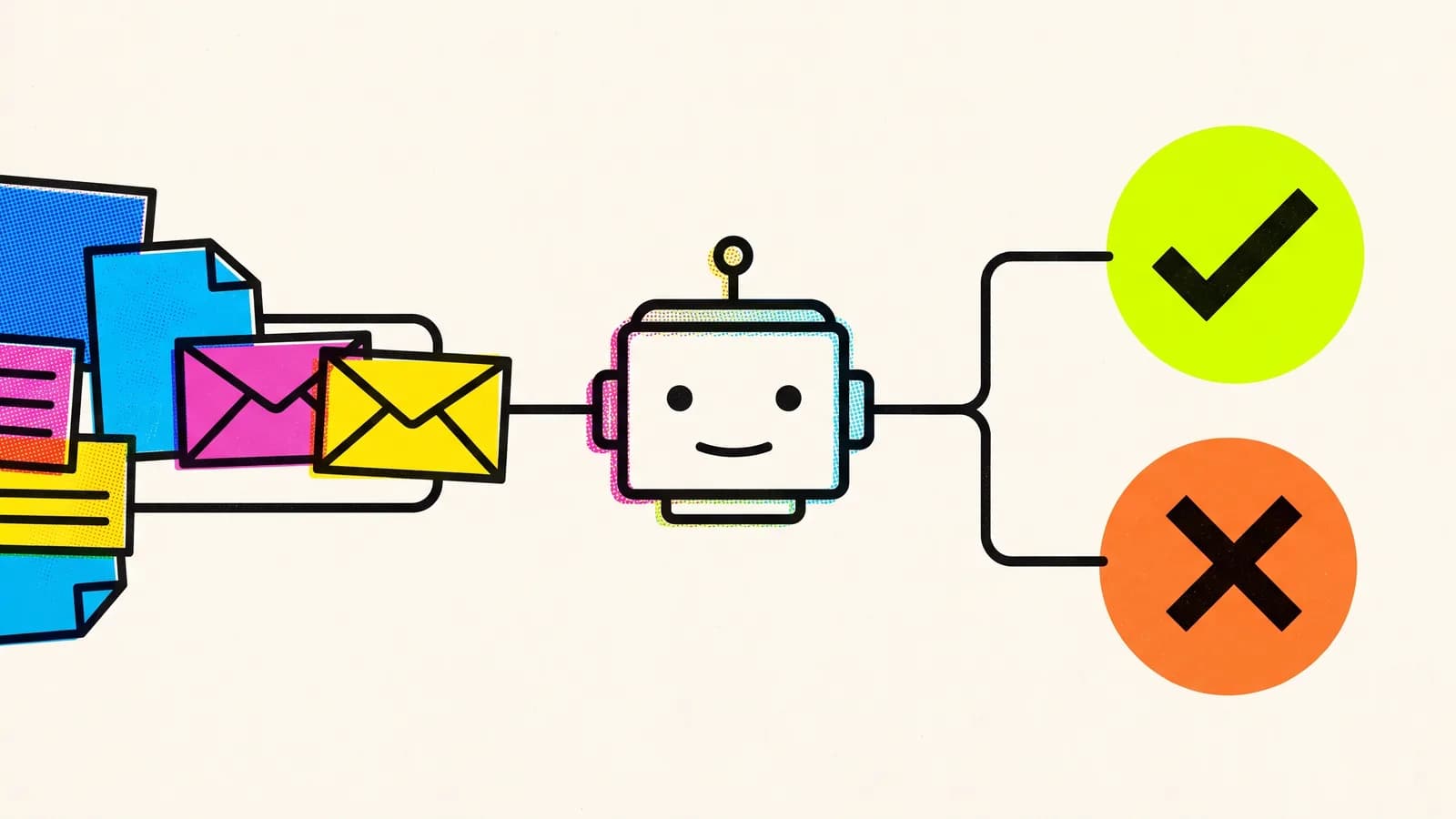
I tested my free AI checker on 172 Dutch texts. Half were written by people between 2016 and 2021, when ChatGPT didn't exist yet. The other half were written by five AI models on the same topics. Of the human texts, 5% scored 60% AI or higher, against 86% of the AI texts. So roughly one in twenty human texts is wrongly flagged, and one in seven AI texts slips through. All those human texts predate ChatGPT, so apparently some people were already writing like ChatGPT before it existed. That's why I don't trust a detector blindly, mine included.
Ten signs of AI writing
1. Em-dashes
In English the em-dash is normal punctuation, and good writers use it too, so a single one proves nothing. What stands out is frequency. Language models reach for it again and again, where a person would use a comma, a period or parentheses. This is the quickest one to find: search your text for the dash and count.
- How AI writes it: “The bakery opens at seven — long before the rest of the street.”
- How it could be better: “The bakery opens at seven, long before the rest of the street.”
2. "Not X, but Y"
The model first states something the reader never thought, only to knock it down. "Not only..., but also" and "It's not just X, it's Y" belong in this group. Most of the time the first half can simply go.
- How AI writes it: “It's not just a website, it's a business card for your company.”
- How it could be better: “A new customer checks your site first to see whether you do this kind of job and roughly what it costs.”
3. A question with the answer right behind it
A short question followed straight away by its answer is meant to build suspense. Once, that works fine. When it comes back in every paragraph, it reads like a trick.
- How AI writes it: “The result? A website that loads faster.”
- How it could be better: “The website now loads in under two seconds, even on a phone.”
4. Everything in threes
Three sounds complete, so a language model picks it often. If almost every paragraph has a list of three, the rhythm gives it away. Name what you can actually point to, even if that is two things or four.
- How AI writes it: “The service is fast, reliable and affordable.”
- How it could be better: “You get a first design within a week, for a fixed price.”
5. Stacked "no"s
A string of negations sounds firm, but the reader still doesn't know what they do get. Put that part in.
- How AI writes it: “No hassle, no hidden costs, no fine print.”
- How it could be better: “You pay a fixed price per month and can cancel anytime, with one month's notice.”
6. Typical AI words
Language models use some words and phrases noticeably often: delve, crucial, seamless, robust, "plays a key role", "ensures that", "in conclusion". They sound weighty and say little. Replace them with something the reader can check, such as a number or a name, or cut them.
- How AI writes it: “A fast website is crucial for a seamless user experience.”
- How it could be better: “If a page loads slowly on a phone, visitors are more likely to leave.”
7. "From ... to ..."
With "from ... to ..." the text tries to pull everyone in. Say who it is really for. A time or an amount ("from 9 to 5") is simply a fact and is not what this is about.
- How AI writes it: “From solo freelancers to global enterprises, there is a solution for everyone.”
- How it could be better: “Most clients are HVAC contractors and builders with five to twenty employees.”
8. Promises with an escape hatch
A promise with "where possible" or "if desired" attached sounds polite. But afterward the reader still doesn't know where they stand.
- How AI writes it: “Where possible, delivery takes two business days.”
- How it could be better: “Order before 4 p.m. and you'll have it within two business days. In August it takes one day longer.”
9. Fortune-cookie wisdom
Openings like "In today's fast-paced world" and "It's no secret that", and clichés like "takes it to the next level" or "makes all the difference", fill space. If the sentence could sit on any company's site, it can go.
- How AI writes it: “In a world where everything moves faster, a good website matters more than ever.”
- How it could be better: “The first line of your homepage says what you do and in which region.”
10. The summing-up closer
Language models like to close with a summary of what you just read. You were there for it already.
- How AI writes it: “In conclusion, with the right approach you can get more out of your website.”
- How it could be better: “Start with the page that gets the most visitors and rewrite its opening paragraph first.”
Sentences that announce something without naming it
There's one more sign that's easy to read past: a sentence that promises something important, like insights or opportunities, but doesn't say what they are. You keep reading, and only at the end of the paragraph do you notice that it never says which ones.
Language models write sentences like this often, because such a sentence fits in any text. People do it too, for example when they're still working out what they actually want to say.
- How AI writes it: “The conversations with customers yielded valuable insights.”
- How it could be better: “The conversations with customers showed that almost nobody fills in the quote form when it asks for a phone number.”
If you spot a sentence like this, you have two options: add what those insights or opportunities are, or cut the sentence. Often you won't even miss it.
Paste your text into the free AI checker. It underlines the sentences with these signs and gives a tip per sentence on how to rewrite it.
CHECK YOUR TEXTHow to rewrite AI text
Swapping words helps very little. You end up with the same empty text in different words. So start with what it says.
Add things only you know: a question a client asked last week, roughly what a job costs, the place where you work, or something that once went wrong. A language model can't know details like that, and they're how your reader notices there's a real business behind the text. Then go through the ten signs and rewrite the sentences where you see them, like in the examples above.
Finally, read the whole text out loud once. Where you stumble, the rhythm is off. Often there are a few sentences in a row that are exactly the same length.
There are also tools that make AI text "human" by shuffling words around. A detector then stops flagging it, while the text still contains nothing that only you know.
Why this matters to you
Google doesn't care whether you write a text with AI. In its guidance on AI content Google writes that it looks at what a page gives the reader. Only when you use AI to produce pages at scale that exist mainly to rank higher does Google call it spam.
The bigger risk is with your reader. AI text is a bit like a stock photo: nothing is wrong with it, but it could have been on any site. After reading it, a customer still knows nothing about you, and then they choose someone else just as easily. If your own examples and prices are in it, they can see who they're dealing with. How to make a text like that easy to find in Google is covered in my post on SEO copywriting.
I use AI when I write too, including for this post. Before anything goes online, I check it myself against these ten signs. I've written before about what else I think of AI in marketing.
Paste your homepage into the AI checker and see which sentences it underlines. It runs on Jev, a model that only judges.