Having a website built costs anywhere between €0 and €30,000. Where you end up between those two amounts depends on what the site needs to do and who builds it. Below I lay out the five price tiers you run into most often. After that you can read which factors set the price and which costs continue after launch.
Website costs at a glance
The table below gives indicative prices for the Dutch market: what freelancers and agencies usually charge. What you get in each price tier is covered in the sections after it.
| Type of website | Indicative price |
|---|---|
| Do it yourself with a builder or AI | €0 |
| Template site from a freelancer | €500 to €1,500 |
| Custom site for a small business | €1,500 to €3,000 |
| High-end site with CMS and SEO strategy | €3,000 to €7,000 |
| Online store | €2,000 to €30,000 |
| Ongoing costs (every website) | €50 to €150 a month |
What you get in each price tier
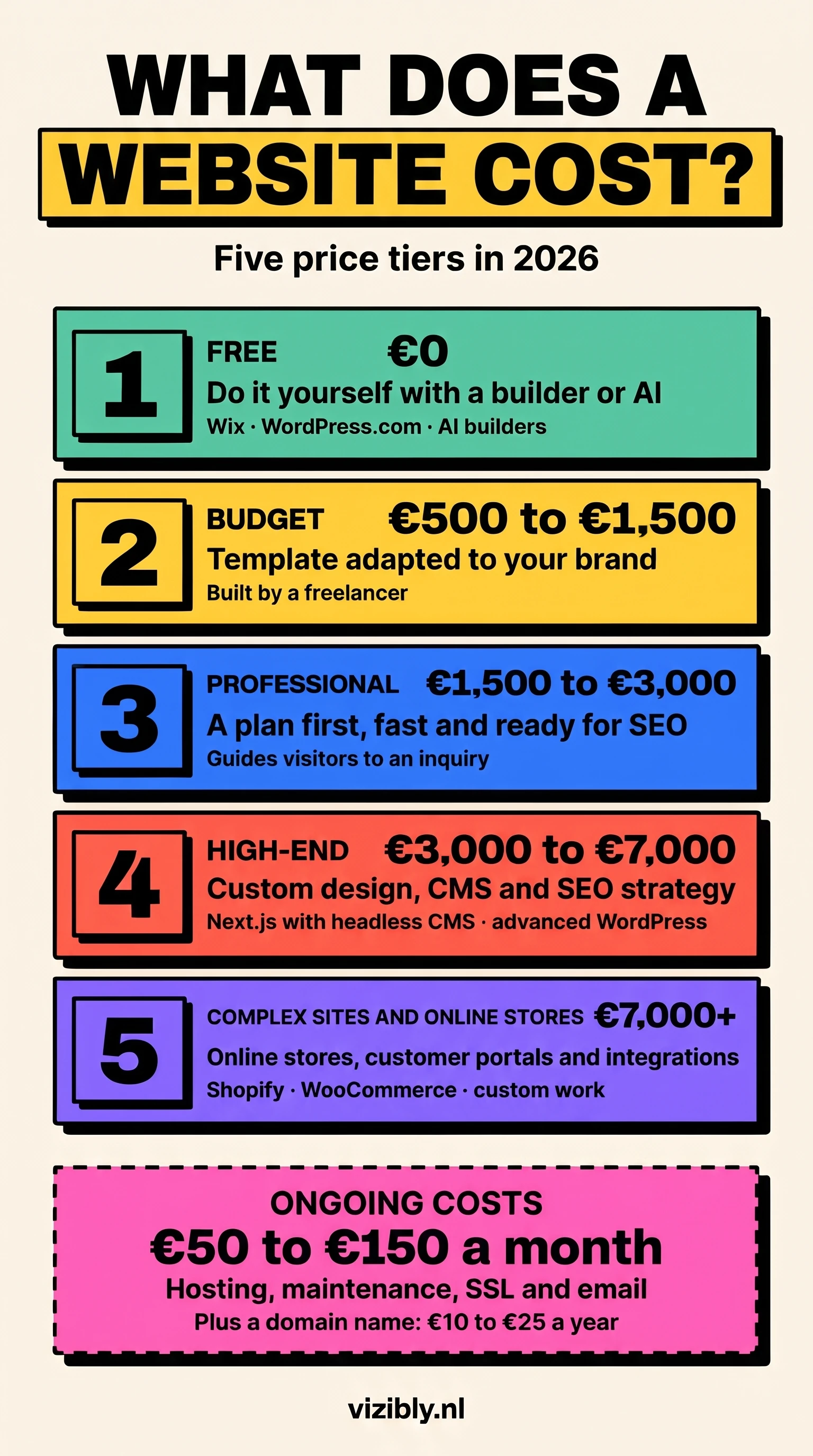
Free: do it yourself with a builder or AI
With tools like Wix, WordPress.com or AI website builders you can put together a working site without a budget. But you get a subdomain (yourbusiness.wixsite.com), limited design choices and little control over speed or SEO. To test an idea or for a first spot online, that is fine. If your website has to bring in clients, you quickly run into the limits of a builder like that.
Budget: €500 to €1,500
In this segment a freelancer adapts an existing template to your visual identity. You get your own domain, a neat design and a contact form. For many self-employed people and small business owners that is a fine starting point. One thing to watch: quality varies enormously. Some freelancers deliver a clean, fast site. Others drop in a template and never look at load speed or SEO.
Professional: €1,500 to €3,000
In this price tier the builder starts with a plan: which pages you need, what a visitor should do and how the design fits your brand. Then they build a site that loads fast, is technically sound for SEO and leads visitors to an inquiry or a phone call. For many small and mid-sized businesses this is the tier that fits best. At Vizibly, websites start from €2,000.
High-end: €3,000 to €7,000
This price tier fits when your website has to become your most important marketing channel. You get a fully custom design, an extensive SEO strategy, a CMS you use to manage your own copy and pages, and, where needed, integrations with the software you already use. The technical work is part of it too: structured data (extra code that tells Google what is on a page), load speed and accessibility. A site like this is often built with Next.js and a headless CMS (a content management system that runs separately from the site), or as an extensive WordPress site with custom plugins.
Complex sites and online stores: €7,000+
This tier covers online stores with hundreds of products, portals where customers log in and sites with integrations to external systems, such as inventory or accounting software. What a project like that costs depends mostly on how complicated those functions and integrations are. As a guide: a relatively simple Shopify store starts at around €2,000, but a store with custom work, product configurations and integrations quickly costs €10,000 to €30,000.
Six factors that set the price
Two quotes for a site with the same number of pages can be far apart. The number of pages says little: the price mostly comes from what the site has to do, and that differs by industry. A website for a plumbing company is about getting called fast in an emergency, a website for an accounting firm is about trust and clear rates, and a restaurant site with reservations needs an integration that always works. Six factors together determine where you end up.
1. Design: template or custom. Adapting an existing template is relatively cheap, because the basic structure is already there. With a fully custom design a designer starts from zero, and that takes more hours. You notice the difference mostly in how unique your site looks and how well the design matches your brand.
2. Functionality. A contact form is quick to build. A quote tool, a product configurator or an integration with your accounting software takes much more development time, and those hours show up in the quote.
3. Content. This cost is often forgotten. If you supply the copy and images yourself, you save a lot. If everything still has to be written and photographed, a copywriter and a photographer come in, and both charge their own rate on top of the build.
4. SEO. A technically clean foundation (fast load time, good structure, meta tags) comes standard with a good builder. But an extensive SEO strategy with keyword research, a content plan and link building is a separate engagement. It runs month after month and you pay for it separately from the build.
5. CMS. Do you want to edit pages and copy yourself? Then you need a CMS (content management system), and that costs extra development time. If your content rarely changes, you can skip that cost.
6. Who builds it. According to the freelancer hourly rate survey by Knab, a Dutch online bank, a self-employed web developer charges an average of €73 an hour in 2026, excluding VAT. An agency usually sits above that, because project management and office costs are part of the rate. A lower rate says little about quality, and quality varies a lot in this trade.
Ongoing costs after launch
The costs don't stop after the build. A website needs regular maintenance, and hosting, software updates and security patches simply keep going. If you do nothing about them, you fall behind on updates after a year, outdated plugins become a security risk and your site slowly gets slower.
Plan on these costs after launch:
Hosting: €5 to €50 a month, depending on the type
Domain name: €10 to €25 a year
SSL certificate: free (Let's Encrypt) to €100 a year
Maintenance and updates: €30 to €100 a month
Email: €1 to €7 a month per mailbox
Total: plan on €50 to €150 a month
Good to know: with WordPress, maintenance costs run a bit higher because of the constant stream of plugin updates and security patches. A site in Next.js or Astro has fewer parts that need updating, so the monthly costs come out lower.
Website on a subscription
Besides the one-off build you also run into subscriptions: you pay little or nothing up front, and then a fixed amount a month that covers the build, hosting and maintenance. The low barrier makes it attractive. Do work it out over a few years, though: €99 a month sounds manageable, but over three years it comes to well over €3,500. For that amount you could also have a custom site that belongs to you.
The biggest thing to watch is ownership. With many subscriptions you are effectively renting the site: stop paying and it's gone. So ask up front who owns the domain, the content and the code, and what happens when you cancel. If that is properly put in writing, a subscription can fit just fine.
Do it yourself, hire a freelancer or an agency?
Doing it yourself works if you have a limited budget and are willing to put time into learning a tool. You save money, but hours go into it. Quality is limited to what the builder allows, and for a personal project or a simple landing page that is often enough.
A freelancer is, for many small and mid-sized businesses, the best balance of price and quality. You pay less overhead than at an agency, and your questions go straight to the person who builds your site. That is how I work too: there is no account manager between you and me. Do pay attention to what happens if a freelancer drops out. So always ask whether the code can be handed over and whether you can get into the hosting and the domain yourself.
An agency offers more certainty that the work continues if someone drops out. You have a team behind you, with specialists for design, development and possibly marketing. You pay for that too: hourly rates are higher and there is more overhead in the process (think project managers, meetings, reports). For larger projects or companies that need long-term support, that can be worth the extra cost.
TIP: Always ask to see earlier work, whether you are talking to a freelancer or an agency. Then run those sites through a speed test, and you'll see whether they load fast too.
How to compare quotes
If you ask for several quotes, you quickly end up comparing apples and oranges. One builder includes copy and photos, another doesn't, and sometimes hosting is missing entirely. So lay quotes side by side on the same five points.
Check these five points in every quote:
1. What exactly do you get? Number of pages, custom or template, and whether copy and photography are included.
2. One-off and ongoing costs separated? Build costs and monthly costs should be listed separately on the quote.
3. Who is the owner? Of the domain, the hosting, the content and the code. These should be in your name.
4. What do extras cost? An hourly rate for later changes prevents arguments.
5. Does it say anything about technology? Load speed and an SEO foundation belong in there just as much as the design.
A cheap website: when is that enough?
Not everyone needs a €3,000 website. If you are just starting out as a self-employed person and your clients mostly come in through word of mouth, a neat site of €500 to €1,000 is a fine start. For an association, an idea you want to test first, a temporary campaign site or a digital business card, even a builder like Wix or Squarespace is enough. If your business grows, you can always step up later.
Extra costs that come with a cheap website
The price a website builder puts up front is usually the bare package. If you want a second language, a cookie banner, a booking system or an integration with your newsletter, you often pay a subscription per feature on top. The domain name is also regularly discounted in the first year, after which the normal price applies. So add those items up before you put two providers side by side.
If you choose the free version, you pay in a different way. The platform puts its own ads on your site, you don't get your own domain name and the features you need to receive clients sit behind an upgrade. You usually take that upgrade only after you have already put hours into the site.
The speed of a cheap site can cost you clients too. According to research from Google, the chance that a mobile visitor leaves right away goes up by 32% when a page takes 3 seconds to load instead of 1. A template full of code you don't use, with a pile of plugins on top, easily reaches those 3 seconds.
Finally, pay attention to who owns the site. With Wix or Squarespace you rent your site: if you later want to move to another provider, you can't take it with you and you start over. With every cheap provider, ask whether the domain will be in your name and whether you can leave with all your files.
If your website has to become your most important source of new clients, it pays to spend more on a site that loads fast and is built so that Google can read it well. You can test how your current site is doing for free with the website checker.
Frequently asked questions about website costs
How much does a simple website cost?
A simple business website usually costs between €500 and €1,500 from a freelancer. Think of a homepage, an about page, a services page and a contact form. With a free builder or AI tool you can start for €0, but then you get a subdomain, limited design and little control over SEO.
What are the ongoing costs of a website?
Plan on €50 to €150 a month for hosting, maintenance, SSL and email. On top of that, a domain name costs €10 to €25 a year. With a WordPress site there are also plugin licenses and security updates. With a modern setup like Next.js, maintenance costs are often a bit lower.
Is an expensive website always better?
Not necessarily. A €5,000 website that brings in no clients ends up costing more than a €1,500 site that does. What matters is whether the investment fits what you want from the site. A self-employed person with mostly local clients does fine with a simple site. If you want to grow through Google, a sturdier foundation will do more for you.
How much does an online store cost?
An online store built on Shopify or WooCommerce starts at around €2,000 to €5,000. That includes a number of product pages, a checkout page and the basic integrations. A professional online store with custom work, integrations and extensive product configurations can cost €5,000 to €30,000 or more. Read more about the choices involved in building a website.
How much does a website on a subscription cost?
With a subscription you pay little or nothing up front and then a fixed monthly amount for the build, hosting and maintenance. Work it out over several years: you often end up paying more than with a one-off build. Pay special attention to ownership, because with many subscriptions you lose the site as soon as you stop paying.
A price for your own website
On the pricing page you can see what a website from Vizibly costs and what you get for it. If you want an estimate for your own plan, get in touch.
SEE PRICING