Ask a business owner what branding is and you usually hear: a logo and a visual identity. Those things are part of it, but they come at the end. Branding is translating your position in the market into a story that sounds the same everywhere: on your website, in your quotes, on the phone. In this article I explain what branding means, why many businesses start at the wrong point, and how to get started with it yourself, even without an agency budget.
What branding means
The shortest definition I know: your brand is what clients think and say about you when you are not in the room. Branding is steering that on purpose. Everything a client sees and hears from you contributes to it: your website, your copy, your quote, your van, how you write your emails. Whether you think about it or not, you have a brand. The question is only whether it matches who you want to be.
If you want a Dutch word for it, merkopbouw (brand building) or merkvoering (brand management) come closest. Dutch business owners themselves usually just say “je merk neerzetten” (putting your brand on the map), and that covers it well.
Much of the explanation about branding starts right at the visible part, the logo and the color palette. As a result, business owners quickly think branding is a design job. It is a strategic job first, and only then a design job.
The order of branding: your position first, the logo later
If you want a new website or a fresher look, the first step is usually to find a logo designer or pick colors. That feels logical, because the logo is the most tangible part of a brand. But a logo is a translation of something. If that “something” isn't settled, you translate nothing and the result is decoration.
The right order is the other way around. First your position in the market: who do you work for, what do you deliver for that client, and what work do you deliberately not do? Then the story that follows from it: why should that client choose you, in plain words. And only then the form: the tone of your copy, your colors, your fonts, your logo. If you work in that order, everything in your brand points the same way. If you start at the logo, you are buying a nice picture for a story that doesn't exist yet.
Branding is your position in the market, translated into a story. Your logo and your colors are part of it, but you only have them designed once you know who you work for.
As a small business owner, that is good news: the strategic part of branding takes mostly thinking and nerve, not a big budget. You can decide who you work for and which jobs you turn down at the kitchen table. An agency can help you with it, but it is not a requirement.
The parts of branding
Branding consists of four layers that build on each other. Each layer supplies the input for the next, so the order is fixed.
Positioning: the foundation
Positioning is the choice everything else follows from: for whom are you the best option, and why? A choice like that also rules things out. Someone who says “I do everything for everyone” hasn't really chosen yet. If you do choose, a client who fits your profile exactly recognizes themselves right away. The rest scrolls on, and that's fine.
Brand story: why you
Your story follows from your position: what do you deliver for your client, and why can you do it better than the rest? That story doesn't have to be a ten-page mission-and-vision document. A few sentences that a client can repeat are enough. What your best client tells a colleague about why they work with you: that is your brand story, and it is often already in your reviews word for word.
Tone of voice: how you sound
Tone of voice literally means the tone of your voice, in other words how your brand sounds in writing. You choose, for example, between formal or casual, short or detailed, with humor or without. Which tone you choose matters less than keeping it up: the same voice on your site as in your emails. As soon as your website sounds different from the business owner who shows up for the meeting, a client feels that something doesn't add up.
Visual identity: how you look
Only in this layer do the logo, colors, typography and imagery come in: together they make up your visual identity. Once the first three layers are in place, the design suddenly becomes a much easier assignment. A designer who knows you are the premium option in your market makes something very different from a designer working for the budget option. Without that input they have to guess, and you end up with a logo that is “nice enough” but says nothing.
Why branding matters, especially for small and mid-sized businesses
Take a look at the websites in your industry. Chances are they look alike: the same promises, the same stock photos. And now that almost anyone can have a neat site made with AI, there will only be more of them.
For your client that means: if your story sounds the same as that of three competitors, one visible difference is left to choose on: the price. Then you only win jobs by being the cheapest. Your margin gets smaller because of it.
Strong branding turns that around. With a face of your own and a sharp story, the clients who get in touch are mostly the ones who fit you exactly, and price shoppers drop off sooner. That effect grows over time, because a recognizable brand gets remembered and passed on. At some point people search for your company name instead of for “dakdekker in de buurt” (roofer near me).
Branding and marketing: the difference
These two are often mixed up, and the distinction is simpler than it seems. Marketing brings people to you: ads, findability in Google, social media, a newsletter. Branding decides what they find when they get there, and whether they remember you.
They need each other. If you advertise without a sharp brand, you pay for visitors who land on an interchangeable site and see no reason to choose you. Conversely, the sharpest story does nothing if nobody gets to see it. The order is really the same as with the logo: your brand sharp first, and only then budget for ads and other channels.
Branding examples: big and small
A well-known Dutch example is Coolblue, an online retailer. Notice that you recognize a Coolblue text even without the logo next to it. That comes from the clear language, the small jokes and a tone that is the same on the box as in the email. Their branding sits mostly in that story and that voice, and the blue and the logo finish it off.
But branding works just as well at small-business scale. An example from my own practice: Bill Incasso, a debt collection agency whose SEO I do. Most debt collection agencies talk about money and threaten: reminders, bailiffs, legal steps. Bill chose a different theme: the business owner's night's sleep. Unpaid invoices cost money and sleep. So the tone is plain and warm instead of threatening, sleep comes back as a motif in the copy, and collecting debts is called “mensenwerk” (work done by people). Through that one theme choice, the whole brand sounds different from the rest of the industry.
Another client: Dutch Survey, a surveying company for industry. It could have presented itself with the usual words about experience and advanced equipment. Instead the positioning is: the experienced colleague you call when you have a tricky measuring problem. You see that in the direct contact without middlemen and in copy that is calm and specific. It says “active in the petrochemical industry for more than 10 years”, because that says more than “years of experience”. You can see how that plays out on the site in the Dutch Survey case study.
Sometimes the positioning is even in the name. Koffienoob, one of my own sites, writes coffee reviews from the beginner's point of view. That name alone makes a choice: this is coffee without snobbery. Someone looking for an accessible review feels welcome, and the coffee purist understands right away that this isn't the place for them.
Getting started yourself: your branding on one page
To begin with, you don't need an expensive branding engagement at an agency. This is the method I use with clients myself, and the core fits on a single page:
- Answer five questions. Who are your best clients? What work do you like doing most? What are you better at than the rest? Which jobs do you deliberately turn down? And how do clients describe you in their own words?
- Collect client language. Take your reviews and emails and write down literally what clients say. Don't rephrase anything: clients' words convince the next client better than yours do.
- Write your positioning sentence. One sentence that chooses and excludes: who you work for, what you are to that client, and what you don't do. For example: “the roofer for historic buildings in the province of Zeeland; no new construction, no flat roofs”. Does it make you a little uncomfortable? Good sign. A sentence nobody can disagree with says nothing.
- Translate it into tone and style. First decide how you sound in writing and then how you look. Colors and logo come in this step, and by then they have a story to build on.
- Apply it everywhere. Above all on your website, because that is where clients decide. Every page tells the same story in the same tone, and your quotes and emails do too.
You can do the first three steps just fine yourself. Building a site that conveys that story and turns visitors into clients is skilled work. At Vizibly, positioning and brand voice are the first phase of every website project: I only start on the design once your one-pager is done.
Frequently asked questions about branding
What is branding, in short?
Branding is deliberately steering how your business comes across: who you work for, what story you tell and how you sound and look. Your logo and visual identity are part of it, but the core is your position in the market, translated into a story that is the same everywhere.
What is the difference between branding and a visual identity?
A visual identity is the visible part: logo, colors, fonts. Branding is the whole: your position, your story, your tone and that visual identity. A visual identity works best when the rest is already settled, because then the designer knows what to express.
What is the difference between branding and marketing?
Marketing gets people to you. Branding decides what they find when they arrive and whether they remember you. Marketing works best when your brand is already sharp, because then the visitors who come in also find a reason to choose you.
Is there a Dutch word for branding?
In Dutch, merkopbouw (brand building) or merkvoering (brand management) comes closest. Business owners usually just say: “je merk neerzetten” (putting your brand on the map).
What does branding cost?
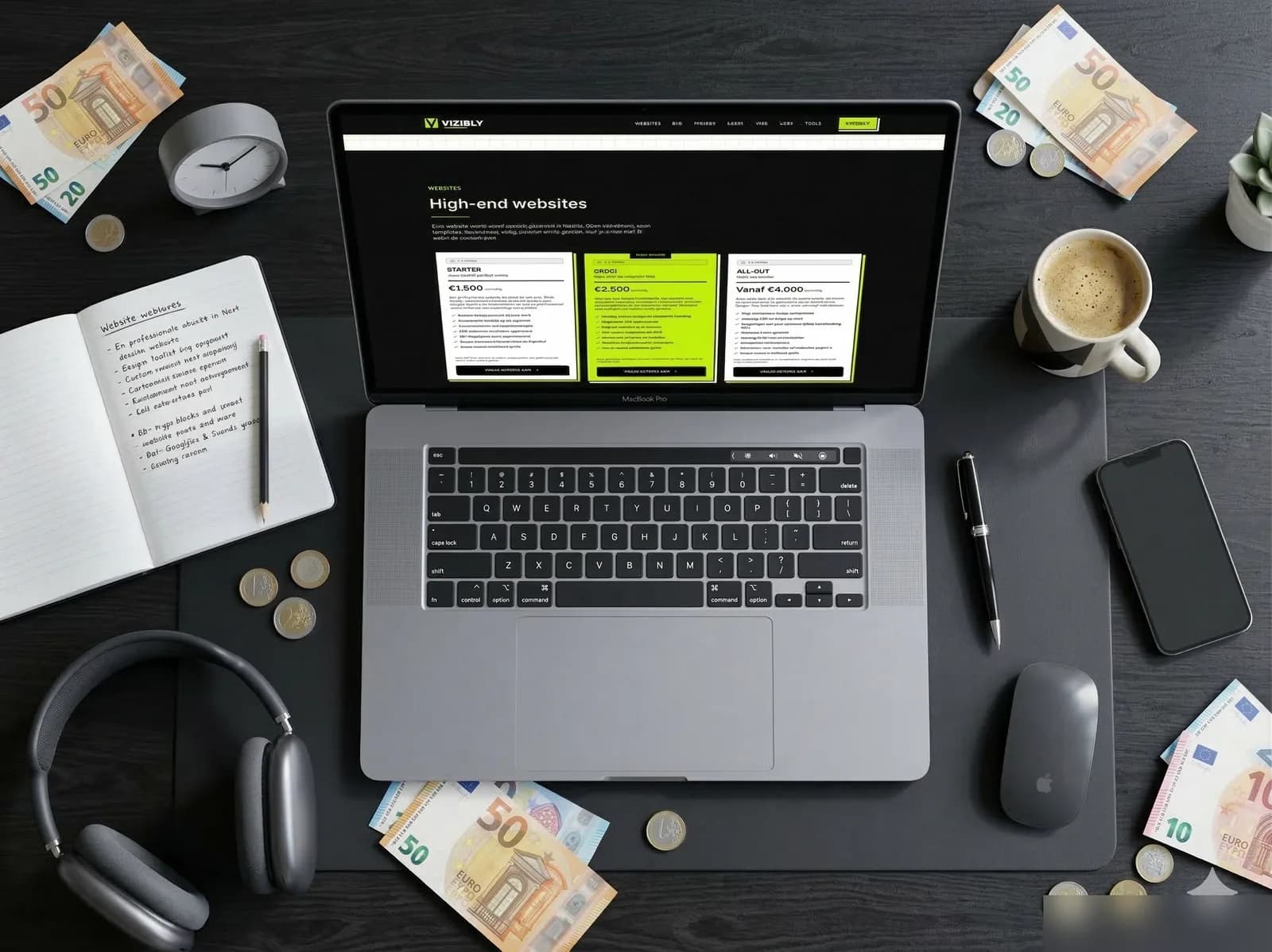
At Vizibly, branding is not a separate service: positioning and brand voice are the first phase of every website project (from €2,000) and are included in the price. On the pricing page you can see what else is included.
Positioning is the first phase of every website project
In the first conversation I put your positioning on a single page together with you, and I build your site on that. Or schedule an intro call right away.
HOW THAT WORKS AT VIZIBLY