More and more people ask ChatGPT, Gemini or Claude which business to choose. Getting found in ChatGPT and other AI assistants is for the most part the same as getting found in Google. Nobody knows exactly how an assistant chooses, but recent research and my own measurements do show a clear pattern. This field is also called GEO, generative engine optimization.
Largely the same work as for Google
Google looks at two things for every search. The first is relevance: does your page answer what someone is looking for? The second is authority: how well known and trusted is your business, for example because other websites link to you.
An AI assistant looks at the same two things and does it a little differently. In Google, what counts most is your own pages and the websites that link to you. An assistant like ChatGPT is trained on everything there is to read about your business, such as forums, YouTube videos, reviews and company pages on LinkedIn. So what can be found about your business outside your own website seems to weigh more heavily in AI than in Google.
On top of that, most assistants look up their answer in a search engine. Gemini uses Google's results for that, and Google's AI answer comes from Google itself. ChatGPT has been reported to use Google's results for part of its answers as well. Its maker has not confirmed that. So a business that is easy to find in Google has a head start at least with Gemini and with Google's AI answer.
Google says so too in its own guide, about its own AI answers: getting found there is still SEO. Google does not use special files or separate texts for AI.
AI mentions the businesses it already knows
The makers of ChatGPT and Claude send programs across the internet that fetch and read pages, just like Google does. That is called crawling. A program like that reads your own website, and also what the rest of the internet says about you: reviews, directories, articles and forums. So your website needs to be reachable for those programs.
The assistant is trained on all that text. If your business name often appears there close to the words of your trade, it remembers that connection. That is what it bases its judgment on when it decides whether your business fits a question. When someone asks for a recommendation, ChatGPT usually first comes up with a few names itself and then looks them up.
An analysis of 57 ChatGPT conversations shows how much that weighs. Businesses that ChatGPT had already put in its own search query appeared in the answer in 69 percent of cases. Businesses that only showed up in the search results, in 2 percent. It is a small measurement, so the direction says more than the exact numbers.
You become known before anyone searches
You build that familiarity outside your own website. Ahrefs studied 75,000 brands and looked at what correlates most strongly with being mentioned by ChatGPT and in Google's AI answers. At the top was how often a brand appears in YouTube videos. How often a brand was mentioned weighed at least as much as the number of viewers. Mentions on other websites came next. Links to your site correlated much less with being mentioned by AI. In Google itself, links still count.
Not every social channel counts equally. AI assistants regularly use LinkedIn as a source, mainly company pages and articles. Instagram and TikTok end up in an answer far less often. Those channels mostly work indirectly. Someone who sees you there a few times looks you up, writes a review or mentions you in an article or on a forum. What matters is that many places write and talk about your business.
The study shows correlation and not cause. Large brands naturally have more videos and more mentions, so it is no guarantee.
Make clear on your site what you do, for whom and where
After ChatGPT has come up with a name, it checks it on the business's website. So that site needs to say in plain words what you do, for whom, in which area and roughly what it costs. Use the words your customers use themselves.
Research among almost 4,800 hospitality businesses in Bali points the same way. Businesses with their own website and businesses with known prices were mentioned by AI assistants clearly more often.
A specific question gives you a better chance than a broad one. On the websites I manage, I see that a business is rarely mentioned for a question like “a good plumber in Utrecht,” and much more often when the question includes a neighborhood, a service or a situation. A page per service and per service area helps the assistant connect you to a question like that.
Reviews and directories
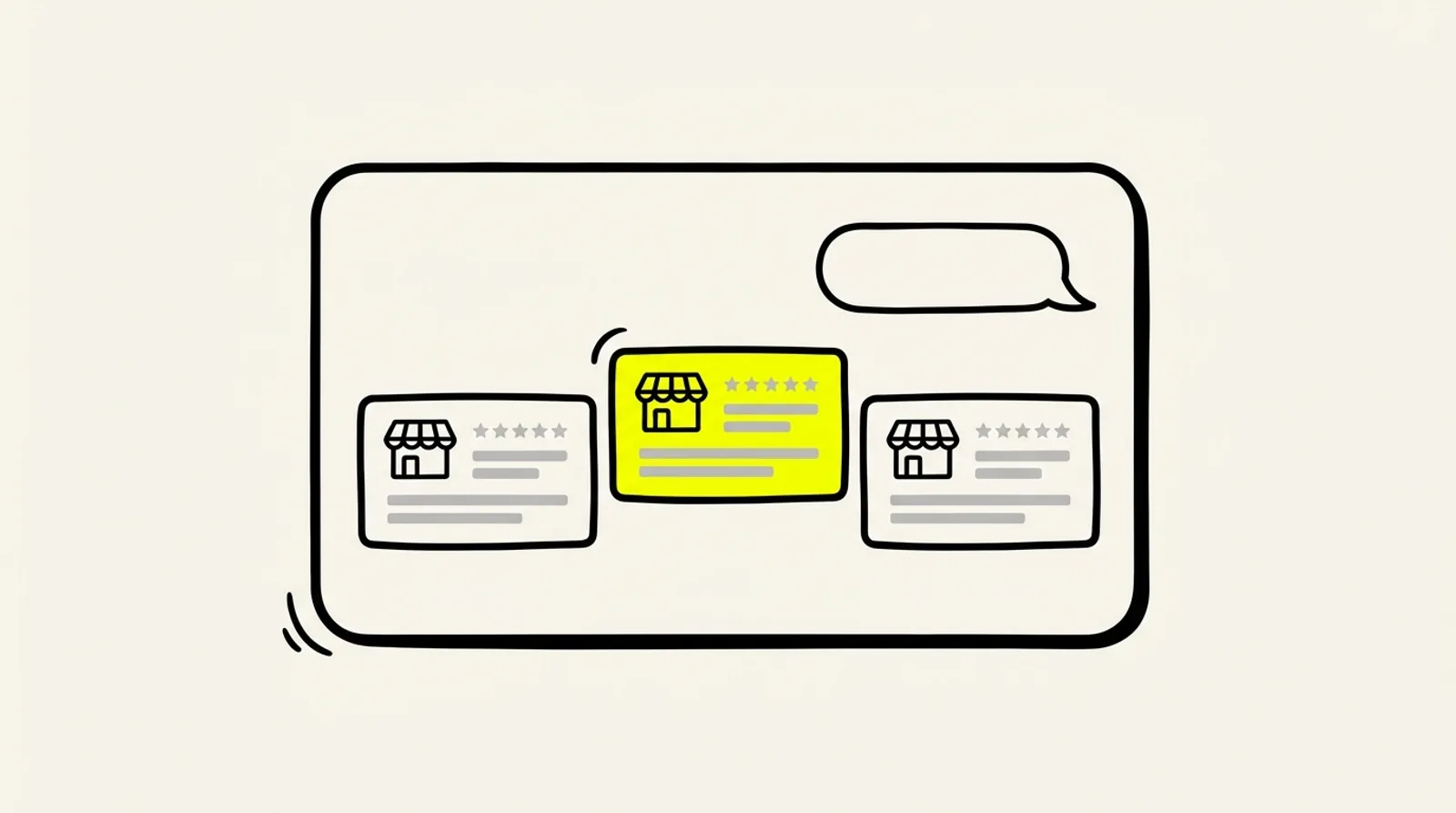
For local businesses, reviews count. ChatGPT often shows local businesses as cards with a rating, the number of reviews and the address. In the Bali study, businesses with more reviews were mentioned more often. The average rating made no difference for that. The rating only counted for the order: businesses with a higher rating were listed first more often.
AI assistants also take their information from directories and comparison sites in your industry. On the websites I manage, I see that ChatGPT regularly mentions a business without using its own site as a source. The name then comes from a directory or a comparison site. So it pays to find out which sources an assistant cites for your customers' questions, and to make sure you are listed well there.
Each system chooses a little differently
The makers do not explain how their system chooses. This overview comes from research by others and from my own measurements.
| System | How it chooses | What counts there |
|---|---|---|
| ChatGPT | First comes up with businesses that fit the question itself and checks them on their own website. Then searches the web, according to reports partly through Google’s results. | Being known in your trade, a website that confirms what you do, and the number of reviews. |
| Google (AI answer and AI Mode) | Splits your question into sub-questions and retrieves pages for each one. | Being easy to find for each of those sub-questions, your Google Business Profile and YouTube. |
| Gemini | Combines what it already knows with Google’s search results. | Your position in Google, your Google Business Profile and lists by others that include you. |
| Claude | Searches through Brave, a smaller search engine, and leans heavily on what it already knows. | How well known your business is, and being findable in Brave. |
Google's AI answer and Gemini lean on Google's search results. ChatGPT does so in part, and Claude searches through a different search engine.
What to leave alone
You read in many places that GEO is the new SEO and that everything has to change now. That is too simple. As described above, it is largely the same work. For Google's AI answers, Google itself says you do not need special AI files, separate texts for AI or a separate page for every possible question. As far as I know, nobody has shown that such things do pay off in ChatGPT or Claude. So do not drop what works for Google to try something new.
Your own list of “the best companies” in your industry, with yourself at the top, can work against you. An analysis from June 2026 looked at lists like that from software companies in Google's AI answers. When Google used the list as a source, the business itself was still not recommended in 69 percent of cases. Websites that published hundreds of those lists also saw their visits from Google drop this year. According to the analysis, more than just those lists played a part in that.
Mentions that are not genuine, only to steer an AI answer, are not a route either. Google counts attempts to manipulate its AI answers as spam.
Why this matters to you
The visits that come in through AI assistants are still small, and Google remains by far the largest source. I do see that visitors who come through an AI assistant generally send a request more often than other visitors. So it is a channel that matters. An AI answer also steers the choice when nobody clicks through: someone who gets three names probably looks at those three first. And what this article describes also helps you in Google. You can read more about that in my article on Google's November update.
For my clients, I measure per assistant how often they are mentioned for questions that do not include their name, and which sources the answer comes from. Since November they see that in their dashboard, in a separate AI overview next to the Google numbers. A fixed position does not exist in AI, and nobody can promise that you will be mentioned. What you can do is make sure your business is known, your website is clear and others write about you.